
Geina buscki
(McDunnough, 1933)
Busck's Plume Moth
Geina buscki is a in the Pterophoridae, first described by McDunnough in 1933. It is a small with a distinctive wing posture that gives it an airplane-like silhouette. The has been documented in southeastern Canada and the eastern United States.
Pronunciation
How to pronounce Geina buscki: //ˈɡeɪ.nə ˈbʌs.ki//
These audio files are automatically generated. While they are not always 100% accurate, they are a good starting point.
Identification
The combination of small size (15 mm wingspan), narrow plumed wings held in an outstretched airplane-like posture, and occurrence in eastern North America distinguishes this . Specific identification features separating it from such as Geina periscelidactylus are not documented in available sources.
Images
Appearance
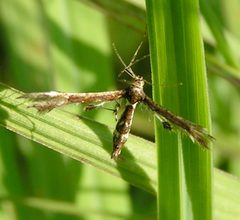
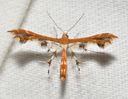
Small with wingspan approximately 15 mm. Wings are deeply divided into narrow, feathery plumes characteristic of the . When at rest, wings are held outstretched in a narrow, angular configuration resembling a winged aircraft. Coloration details are not well documented in available sources.
Distribution
Southeastern Canada and eastern United States, with records from Tennessee and Mississippi. Distribution records also indicate presence in Canada (CA) and United States (US) broadly.
Behavior
Holds wings in a distinctive outstretched posture when at rest, creating a narrow, winged airplane-like silhouette.
Similar Taxa
- Geina periscelidactylusSimilar in same with overlapping eastern North American range; specific distinguishing features require closer examination.
- Other Geina speciesCongeneric plume moths share the characteristic wing shape and posture; identification to level requires detailed examination.
More Details
Observation Frequency
As of source date, the has relatively few documented observations (16 on iNaturalist), suggesting it may be underreported or genuinely uncommon.