Colias tyche
(Böber, 1812)
Booth's sulphur, pale Arctic clouded yellow
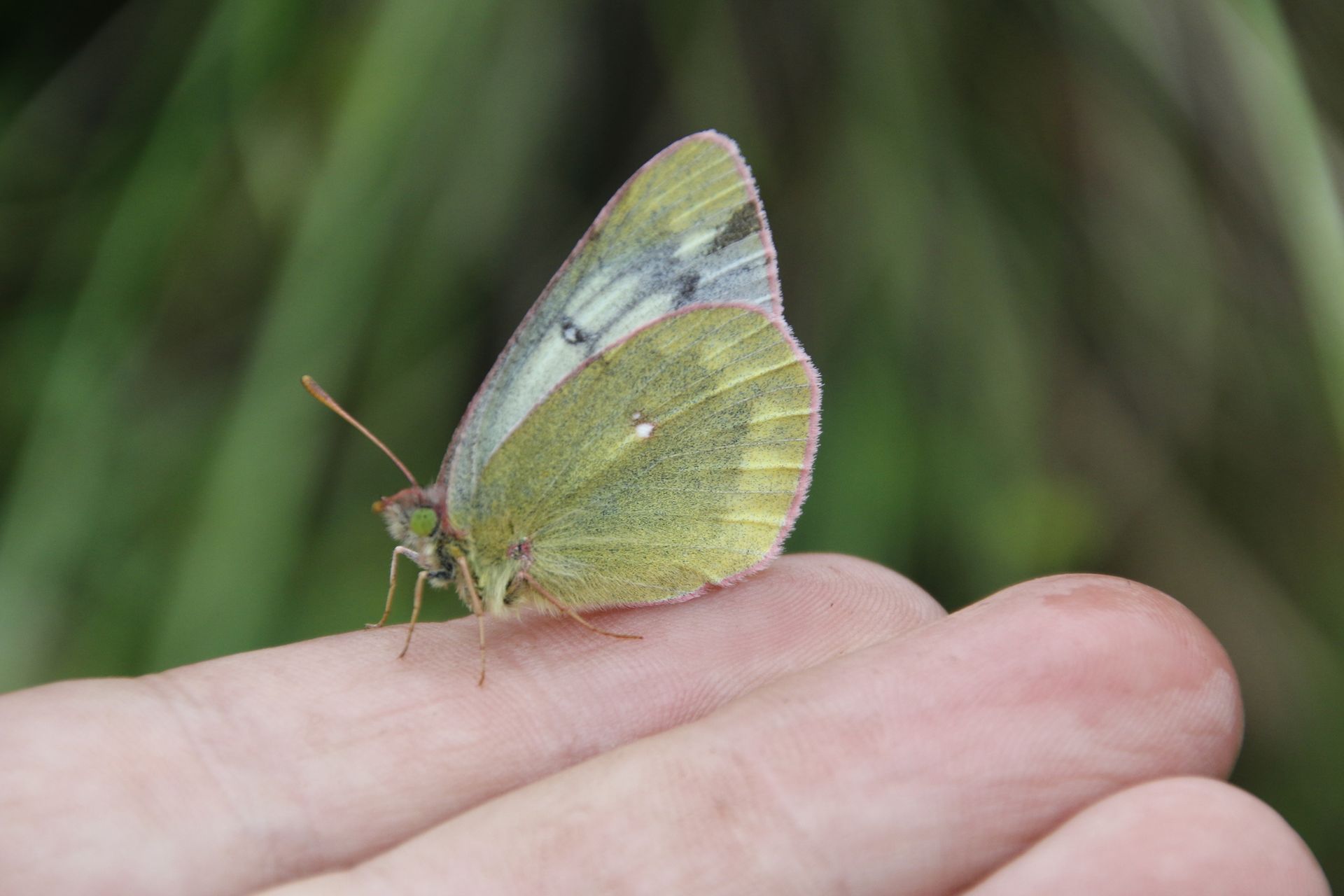
Colias tyche is a small to medium-sized in the Pieridae, distinguished by its pale green to greenish-white or greenish-yellow wings with visible brown and grey-green suffusion on the hindwing bases. The exhibits in wing borders: males have dark borders with pale yellow spots, while females have wider dark borders with black spots. It is one of the northernmost Colias species, with a Holarctic distribution spanning Arctic and subarctic regions of North America and Eurasia. The species name references Tyche, the Greek deity of chance and luck.
Pronunciation
How to pronounce Colias tyche: /ˈkɒliæs ˈtɪki/
These audio files are automatically generated. While they are not always 100% accurate, they are a good starting point.
Identification
Distinguished from other Arctic and subarctic Colias by its pale greenish (rather than yellow or orange) wing coloration and prominent brown wing . Differs from C. hecla (Hecla sulphur) and C. nastes (Labrador sulphur) in wing color and pattern details. The greenish-white females of C. philodice vitabunda may appear similar but differ in distribution and . identification requires examination of geographic origin and subtle wing pattern differences; some Nearctic (boothii, thula) are treated as full by some authors.
Images
Habitat
Arctic and subarctic tundra and taiga environments. Associated with coastal and inland Arctic regions including tundra, tundra-forest transition zones, and northern areas. Larval includes areas supporting legume plants.
Distribution
Holarctic. North America: Baffin Island, Hudson Bay coasts, Nunavut and Northwest Territories mainland, southern tier of Arctic Islands, northern Yukon, Alaska. Eurasia: northern Europe, northern Siberia including Taimyr Peninsula, Chukot Peninsula, Wrangel Island, Magadan region. Multiple described reflect this broad geographic range.
Seasonality
fly June to August depending on location. Single-brooded in most of range due to short Arctic growing season.
Diet
Larvae feed on legume (Fabaceae). Specific plant records are limited but include various legumes in tundra and .
Host Associations
- Fabaceae - larval legume
Life Cycle
Complete . and larval stages occur on legume plants. presumably in soil or litter. stage not explicitly documented but likely as larva or pupa given Arctic climate. Development constrained by short Arctic growing season.
Ecological Role
in Arctic and subarctic . Larvae are herbivores on legumes. Serves as prey for Arctic including birds and predatory insects.
Human Relevance
Subject of lepidopterological study due to its Arctic distribution and taxonomic complexity. Some (particularly Nearctic boothii and thula) are of conservation interest and subject to taxonomic debate. Not an agricultural pest.
Similar Taxa
- Colias heclaHecla sulphur; similar Arctic distribution but differs in wing color and pattern
- Colias nastesLabrador sulphur; similar but geographically separated and morphologically distinct
- Colias philodice vitabundaFemales often white and may appear similar; differs in more southern distribution and
More Details
Taxonomic complexity
The Nearctic C. t. boothii (Booth's sulphur) and C. t. thula (Thula sulphur) are treated as valid by some authors, reflecting ongoing taxonomic debate about species limits in this complex. Recent subspecies descriptions (antonkozlovi, 2020; several 2001 descriptions from Russian Far East) indicate active research on geographic variation.
Etymology
Named for Tyche, Greek deity of chance and luck, continuing the Classical tradition of naming Colias after mythological figures.
Sources and further reading
- BugGuide
- Wikipedia
- GBIF taxonomy match
- iNaturalist taxon
- NCBI Taxonomy
- Catalogue of Life
- A Butterfly Invasion in Yolo, Solano and Sacramento Counties | Bug Squad
- 'Battus philenor! Battus philenor!' | Bug Squad
- A Boy, Bugs, a Birthday and the Bohart | Bug Squad
- The Joy of Rearing Monarchs | Bug Squad
- Thinking of Noted Cotton Entomologist Thomas Frances Leigh | Bug Squad
- DNA Barcoding Reveals Diversity of Parasitoid Wasps in Smoky Mountains