
Papilio polyxenes asterius
(Stoll, 1782)
Eastern Black Swallowtail
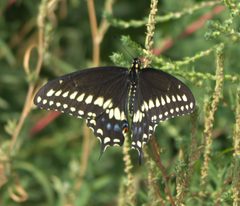
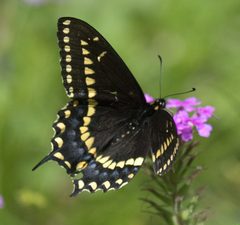
Papilio polyxenes asterius, the Eastern Black Swallowtail, is a widespread of black swallowtail found throughout eastern and midwestern North America. are distinguished by black wings with yellow markings and blue and orange spots on the hindwings; males have more extensive yellow bands while females are darker with reduced yellow. The caterpillars feed on plants in the carrot (Apiaceae) including parsley, dill, fennel, and carrot, as well as wild like Anne's lace. Larvae employ remarkable defenses: young instars mimic bird droppings, while older caterpillars display a bright orange, forked osmeterium that emits foul-smelling isobutyric and methylbutyric acids when disturbed. The completes multiple annually in southern regions, with up to two generations in northern , and overwinters as pupae.

Pronunciation
How to pronounce Papilio polyxenes asterius: /pəˈpɪlioʊ pəˈlɪksəniz æˈstɪriəs/
These audio files are automatically generated. While they are not always 100% accurate, they are a good starting point.
Identification
identified by black wings with yellow bands, blue hindwing scaling, and orange eyespots near short tails. Males have more yellow; females darker with larger orange spots. Caterpillars: early instars are black with white "saddle" resembling bird droppings; mature larvae are green with black transverse bands and yellow spots, with bright orange osmeterium visible when disturbed. Chrysalis resembles dead wood or plant debris, attached by silk girdle and . Distinguished from similar black swallowtails by range (eastern North America), plant use, and specific pattern of blue/orange spots.
Images
Habitat
Open areas including gardens, fields, meadows, roadsides, and disturbed . Frequents areas with abundant nectar sources and larval plants in the carrot . Found from sea level to moderate elevations, adaptable to urban and suburban environments where host plants are cultivated.
Distribution
Eastern and midwestern United States, southern Canada from Manitoba eastward, and northern Mexico. Range extends west to the Rocky Mountains in the United States, with related (P. p. polyxenes) in the west. Absent from most of the Great Plains and western mountain regions where replaced by western subspecies.
Seasonality
Multiple annually: two generations in northern parts of range (May–June and July–August), three or more in southern regions. active from spring through fall, with peak abundance varying by latitude. Overwinters as pupae, with timed to spring warmth.
Diet
nectar on a variety of flowers including milkweeds, thistles, clovers, and garden flowers like phlox and zinnia. Larvae are herbivores on Apiaceae (carrot ): cultivated include parsley, dill, fennel, carrot, and celery; wild hosts include Anne's lace (Daucus carota), poison hemlock (Conium maculatum), and water hemlock (Cicuta spp.).
Host Associations
- Daucus carota - larval Anne's lace, common wild
- Conium maculatum - larval Poison hemlock, toxic to humans but palatable to larvae
- Cicuta spp. - larval Water hemlock
- Petroselinum crispum - larval Parsley, common garden
- Anethum graveolens - larval Dill
- Foeniculum vulgare - larval Fennel
- Daucus carota sativus - larval Cultivated carrot
- Apium graveolens - larval Celery
- Asclepias spp. - nectar sourceMilkweeds
- Vinca spp. - nectar sourcePeriwinkle, noted as especially attractive
Life Cycle
Complete with four stages: , larva (5 instars), pupa (chrysalis), and . Eggs laid singly or in small clusters on plant foliage, hatch in 4–9 days. Larval stage lasts 10–30 days depending on temperature and food quality. occurs on host plant or nearby structures; chrysalis attached by silk girdle and hooks. Summer pupae emerge in 9–18 days; pupae and emerge in spring. Multiple generations annually in most of range.
Behavior
Males establish territories on hilltops and ridge summits, engaging in aerial combat with intruding males; collisions audible to human observers. Females ascend hills to mate, then disperse to oviposit. are strong fliers, active during daylight hours. Caterpillars display unique defense: when disturbed, evert orange, forked osmeterium from thoracic segment, emitting foul-smelling compounds (isobutyric and methylbutyric acids) that repel ants and other . Young larvae also practice fecal pellet flicking to eliminate olfactory cues.
Ecological Role
Larval herbivore on Apiaceae, occasionally reaching pest levels in herb gardens. , visiting diverse flowering plants. Serves as prey for birds, , and other natural enemies; chemical from plants provides some protection. Mimicry complex involves females resembling unpalatable Pipevine Swallowtail, potentially conferring protection from .
Human Relevance
Admired as garden and . Occasionally considered pest when caterpillars defoliate parsley, dill, fennel, and carrot crops in home gardens. Easily attracted to gardens by planting plants. Subject of citizen science observation and photography. Caterpillars sometimes relocated from herb gardens to wild host plants by gardeners wishing to preserve butterflies without sacrificing herbs.
Similar Taxa
- Papilio polyxenes polyxenesWestern with similar appearance but distribution west of Rocky Mountains; some differences in wing pattern intensity
- Battus philenorPipevine Swallowtail; females of P. p. asterius mimic this , but B. philenor has more extensive blue iridescence on hindwings and different pattern
- Papilio troilusSpicebush Swallowtail; similar size and tail shape but has green scaling on hindwings and different spot pattern, different plants (Lauraceae)
- Papilio glaucusEastern Tiger Swallowtail; much larger, yellow or black morphs, striped rather than spotted pattern, different plants (various trees)
Sources and further reading
- BugGuide
- GBIF taxonomy match
- iNaturalist taxon
- NCBI Taxonomy
- Erebidae | Beetles In The Bush | Page 2
- Parsley poacher: Black swallowtail caterpillar, Papilio polyxenes — Bug of the Week
- Bug Eric: Black Swallowtail
- Archive — Bug of the Week
- Bird droppings? Nope, clever moths and caterpillars looking like poop: Beautiful wood-nymph, Eastern tiger swallowtail, Black swallowtail, Red-spotted purple — Bug of the Week
- Missing bugs of the week: Swallowtail butterflies, Papilionidae — Bug of the Week
- Eastern Black Swallowtail: Papilio polyxenes asterius (Stoll) (Insecta: Lepidoptera: Papilionidae)