
Megisto rubricata
(W.H. Edwards, 1871)
Little Wood Satyr
Megisto rubricata, the Little Wood Satyr, is a small to medium-sized satyrine found in eastern North America. The was originally described by William Henry Edwards in 1871 and has been transferred to the Euptychia in some taxonomic treatments, though Megisto remains widely used in North American literature. are characterized by their brown coloration with distinct eyespots on the wings. The species inhabits woodland edges and openings where its larval grasses grow.
Pronunciation
How to pronounce Megisto rubricata: /məˈɡɪstoʊ ˌruːbrɪˈkeɪtə/
These audio files are automatically generated. While they are not always 100% accurate, they are a good starting point.
Identification
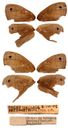
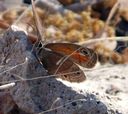
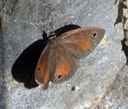
Distinguished from the closely related M. cymela (Common Wood Satyr) by smaller size, more rounded wings, and reduced eyespot development on the hindwing. M. rubricata typically shows two eyespots on the forewing and one to two on the hindwing, compared to M. cymela's larger and more numerous eyespots. The wing margins are less angular than in M. cymela. Underside ground color is warmer brown with less grayish tone than M. cymela.
Images
Habitat
Deciduous and mixed woodlands, forest edges, and partially shaded openings with abundant grasses. Found in moist to mesic environments including woodland trails, powerline clearings, and forest margins where larval grasses receive partial sunlight.
Distribution
Eastern North America from southern Ontario and Quebec through the northeastern United States, south to northern Georgia and west to eastern Minnesota and Iowa. Absent from the southeastern coastal plain and most of the Great Plains.
Seasonality
Single brooded; fly from late May through July, with peak varying by latitude. Northern emerge later than southern populations.
Diet
Larvae feed on grasses (Poaceae), specifically recorded from Poa and other woodland grass . do not visit flowers; instead they feed on sap flows, rotting fruit, , and other non-floral sources.
Life Cycle
stage lasts approximately one week. Larvae feed on grasses and overwinter in mid-instar, resuming feeding in spring. occurs in late spring on or near plants. emerge in early summer and do not overwinter.
Behavior
have a weak, bobbing pattern characteristic of satyrines, typically remaining within a few meters of the ground. Males patrol woodland edges and openings seeking females. Both sexes frequently rest on low vegetation with wings closed, showing the cryptic underside. Adults rarely visit flowers, instead being attracted to non-floral moisture and nutrient sources.
Ecological Role
Larval herbivore on woodland grasses; contributes to nutrient cycling in forest understory. serve as prey for birds and other .
Human Relevance
Occasionally encountered by hikers and naturalists in eastern woodlands; not of economic importance. Used as an for mature deciduous forest in some conservation assessments.
Similar Taxa
- Megisto cymelaLarger size, more angular wings, more numerous and larger eyespots, grayer underside ground color, broader geographic range extending farther south and west
- Cercyonis pegalaMuch larger size, more robust build, eyespots with distinct pupils, more open preferences including prairies and fields