
Morpho polyphemus
Westwood, 1850
White Morpho, Polyphemus White Morpho
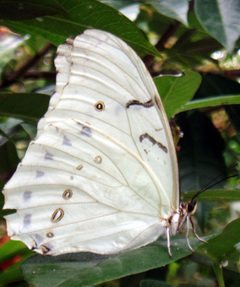
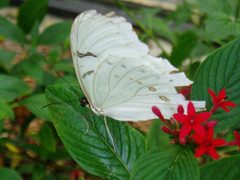
Morpho polyphemus is a distinctive white found in Mexico and Central America, notable for being one of the few Morpho that lacks the characteristic blue iridescence of its . Its wings are chalky white with a subtle mother-of-pearl gloss, and the species bears small eyespots on the hindwing underside—features that inspired its mythological name. The butterfly exhibits rapid, irregular and has been recorded at elevations up to 1,200 meters.

Pronunciation
How to pronounce Morpho polyphemus: /ˈmɔːr.foʊ ˌpɑːl.ɪˈfiː.məs/
These audio files are automatically generated. While they are not always 100% accurate, they are a good starting point.
Identification
Both upper and lower wings are bright white with small light brown markings, differing from the iridescent blue coloration typical of most Morpho . The forewing has a projecting apex and the hindwing displays sharp teeth along the margin. A diagnostic row of small eyespots occurs on the underside of the hindwings—the trait from which the species derives its name. The discocellular shows a narrow dark stripe, and the black bordering present in related species is absent on the upper surface.
Images
Habitat
Found in timber-forest , often near the ground in villages or high around tree tops. In Guatemala, has been recorded ascending to 1,200 meters elevation.
Distribution
Mexico to Guatemala and Nicaragua; occasionally recorded in Panama and Rica.
Diet
Caterpillars have been observed feeding on Paullinia pinnata (Sapindaceae) and Inga (Fabaceae).
Behavior
is extremely rapid and irregular. have been observed flying near the ground in villages and high around tree tops in forested areas.
Similar Taxa
- Morpho lunaAlso white; some authorities treat it as a of M. polyphemus rather than a distinct . Differs in having unusually well-developed black spots on both wings.
- Morpho catenariusBrazilian relative with smaller forewing ocelli and less distinctly white-centered hindwing ocelli compared to M. polyphemus.
Sources and further reading
- BugGuide
- Wikipedia
- GBIF taxonomy match
- iNaturalist taxon
- NCBI Taxonomy
- Catalogue of Life
- Native Bees to Share Spotlight at Bohart Museum Open House | Bug Squad
- A Moth's Nighttime Visit Turns Into Remembrances of Alice--and an Educational Video | Bug Squad
- Don't Miss Bohart Museum Open House on Moths! | Bug Squad
- Silk Textile Displays Grab Attention at Bohart Museum's Moth Night | Bug Squad
- Silkworm Moths, Blacklighting, Hot Chocolate, Cookies and More | Bug Squad
- Turbo Testudine | Beetles In The Bush