
Hypanartia
Hübner, 1821
mapwings
Species Guides
1- Hypanartia lethe(Orange Mapwing)
Hypanartia is a of medium-sized nymphaline butterflies commonly known as mapwings, distributed from Mexico through South America. The genus comprises approximately 14 with its center of diversity in high Andean cloud forest . Phylogenetic studies indicate a possible sister relationship with temperate genera including Polygonia, Aglais, and Nymphalis. The genus has been subject to recent taxonomic revision, with several new species described from Andean localities.
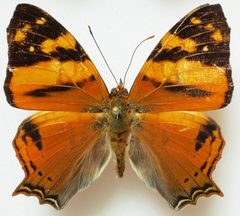
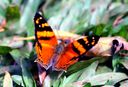
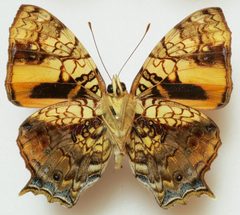
Pronunciation
How to pronounce Hypanartia: /hɪˌpænˈɑːrtiə/
These audio files are automatically generated. While they are not always 100% accurate, they are a good starting point.
Identification
Members of Hypanartia can be distinguished from related by genitalic and wing pattern characteristics, though specific diagnostic features vary by . The genus shares general nymphaline characteristics including reduced forelegs. Detailed identification requires examination of male genitalia and abdominal morphology.
Images
Habitat
Montane in the Neotropical region, particularly high Andean cloud forests. The center of occurs in Andean elevations, with some exhibiting elevational distribution patterns.
Distribution
Mexico to South America, with emphasis on Andean distributions throughout the Neotropical region.
Host Associations
- Fabaceae - larval plantFirst recorded plant for the , representing a new association for both Hypanartia and the Neotropical Nymphalinae
Similar Taxa
More Details
Speciation Mechanisms
Phylogenetic studies provide evidence that speciation across elevational gradients occurred twice in the , both times into elevations largely unoccupied by Hypanartia, followed by subsequent in situ radiation. Differentiation in allopatry between montane regions appears to have been of recent influence only.
Taxonomic History
Recent systematic revision described four new (H. celestia, H. cinderella, H. fassli, H. trimaculata) and two new (H. dione disjuncta, H. trimaculata autumna), placed H. arcaei as a subspecies of H. dione, and designated lectotypes for eight nominal .
Sources and further reading
- BugGuide
- Wikipedia
- GBIF taxonomy match
- iNaturalist taxon
- NCBI Taxonomy
- Catalogue of Life
- The life history of Hypanartia dione dione (Lepidoptera: Nymphalidae) in northeastern Ecuador
- Fabaceae, a new host plant family for Hypanartia and for the Neotropical Nymphalinae (Lepidoptera: Nymphalidae)
- Systematics of Hypanartia (Lepidoptera: Nymphalidae: Nymphalinae), with a test for geographical speciation mechanisms in the Andes