
Aglais milberti
(Godart, 1819)
Milbert's Tortoiseshell, Fire-rim Tortoiseshell
Aglais milberti is a medium-sized native to North America and the only representative of the Aglais on the continent. It is one of two tortoiseshell butterfly in North America, distinguished by its black wings with wide orange to yellow submarginal bands. hibernate through winter and produce two annually. The species occupies diverse moist across a broad geographic range spanning Canada, Alaska, and most of the continental United States.
Pronunciation
How to pronounce Aglais milberti: /ˈæɡ.laɪs ˈmɪl.bɛr.tiː/
These audio files are automatically generated. While they are not always 100% accurate, they are a good starting point.
Images
Appearance
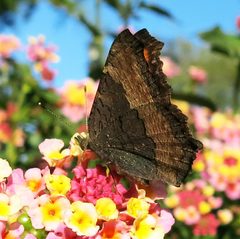
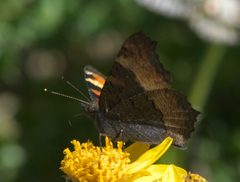
Wingspan 4.2–6.3 cm. Forewing tips squared off. Upperside black with wide orange submarginal bands that fade to yellow near the inner edge. Both wings have narrow black marginal borders; hindwing may display blue spots.
Habitat
Occurs in wet areas including moist pastures, marshes, moist trails, and roadsides.
Distribution
All of Canada and Alaska south of the tundra; all of the western United States; most of the eastern United States.
Seasonality
Two from May to October. hibernate through winter.
Diet
feed on nectar (thistle, goldenrod, lilac), plant sap, rotting fruit, and . Larvae feed on stinging nettle (Urtica dioica), tall nettle (Urtica procera), and clearweed (Pilea pumila).
Life Cycle
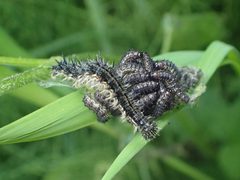
Females lay in bunches of up to 900 on the underside of plant leaves. Early-instar caterpillars feed together in a web; later instars feed alone. hibernate, often in small congregations. Adults have been observed mating in low-elevation watercourses in arid regions.
Behavior
A rapid, quick-flitting that moves rapidly around woodland roads. When landing, individuals often open their wings while perched on trees or rocks.
Similar Taxa
- Nymphalis californica (California Tortoiseshell)The only other tortoiseshell in North America; distributions overlap in some regions but have separate patterns.