
Eueides
Hübner, 1816
Species Guides
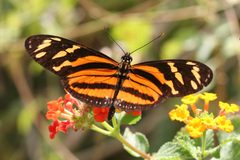
1- Eueides isabella(Isabella's longwing)
Eueides is a of longwing butterflies in the Nymphalidae, Heliconiinae. The genus comprises approximately 12 recognized distributed primarily in the Neotropics. Eueides species are closely related to Heliconius and share the characteristic elongated wings and bright coloration typical of heliconiine butterflies. The genus has been subject to taxonomic revision and phylogenetic study, particularly in relation to the evolutionary development of the Heliconius-Eueides clade.
Pronunciation
How to pronounce Eueides: /juːˈiːɪdiːz/
These audio files are automatically generated. While they are not always 100% accurate, they are a good starting point.
Identification
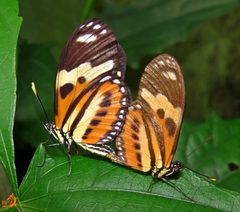
Eueides can be distinguished from the closely related Heliconius by generally more elongated forewings and often less complex wing patterning. Specific identification to species level requires examination of wing pattern elements including band width, coloration (orange, yellow, or white markings on black background), and hindwing margin shape. Eueides isabella and Eueides lybia are among the more frequently observed species and can be recognized by their distinctive longitudinal wing stripes.
Images
Habitat
Tropical and subtropical forest , including primary and secondary forests. Specific habitat associations vary by ; some occupy lowland rainforests while others range into montane forest zones.
Distribution
Neotropical region, with records from Mexico through Central America and throughout South America including Brazil, Colombia, and Amazonian regions. Distribution records include protected areas such as Parque Nacional Natural Serranía de Chiribiquete in Colombia.
Similar Taxa
- HeliconiusClosely related heliconiine with overlapping distribution and similar elongated wing ; Heliconius typically shows more complex wing patterns and diverse color forms
Sources and further reading
- BugGuide
- Wikipedia
- GBIF taxonomy match
- iNaturalist taxon
- NCBI Taxonomy
- Catalogue of Life
- The heliconians of Brazil (Lepidoptera: Nymphalidae). Part III. Ecology and biology of Heliconius nattereri, a key primitive species neat extinction, and comments on the evolutionary development of Heloconius and Eueides