
Eueides isabella
(Cramer, 1781)
Isabella's longwing, Isabella's heliconian
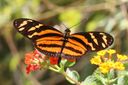
Eueides isabella is a large nymphalid in the Heliconiinae , found from Mexico through the Amazon basin and the West Indies. are active year-round in tropical and are known to fly even in low light conditions. The exhibits classic heliconiine traits including long adult lifespan and specialized pollen-feeding . Caterpillars are gregarious, with distinctive white and black coloration and long black spines.


Pronunciation
How to pronounce Eueides isabella: //juːˈiːɪdiːz ˌɪzəˈbɛlə//
These audio files are automatically generated. While they are not always 100% accurate, they are a good starting point.
Identification
Distinguished from similar heliconiines by combination of dark brown ground color with orange bands and yellowish forewing edge markings. Underside blue spots on hindwing edges are diagnostic. Similar include Heliconius ismenius, Lycorea halia, and several Mechanitis species, which differ in pattern details and wing shape.
Images
Habitat
Rainforest , from sea level to approximately 1500 m elevation. Remains primarily in upper forest strata.
Distribution
Mexico to Amazon basin and West Indies. Specific records include French Guiana, Suriname, Trinidad, Colombia, Cuba, Puerto Rico, Central America, Peru, Ecuador, Venezuela, Haiti, Antilles, and Brazil.
Seasonality
Active year-round in tropical ; no seasonal restriction.
Diet
feed on nectar and pollen. Caterpillars primarily feed on Passiflora platyloba and Passiflora ambigua.
Host Associations
- Passiflora platyloba - larval food plantprimary
- Passiflora ambigua - larval food plantprimary
Life Cycle
Caterpillars are gregarious. Complete with , larval, pupal, and stages. Adults are long-lived relative to most butterflies.
Behavior
active even in low light conditions. Exhibits trap-lining : traverses defined route through forest to visit flowers presenting fresh pollen, a behavior common among long-lived tropical . After collecting pollen on , secretes to release and nutrients, which are absorbed through proboscis .
Ecological Role
in tropical rainforest . Specialized pollen-feeding contributes to nutrient cycling and supports extended lifespan. Larval feeding on Passiflora represents herbivore-plant interaction in .
Similar Taxa
- Heliconius ismeniusSimilar orange and black pattern; differs in specific band arrangement and wing shape
- Lycorea haliaTiger mimic-queen with convergent coloration; distinct wing venation and pattern details
- Mechanitis lysimniaConfused tigerwing with similar warning coloration; differs in wing shape and spot pattern
- Mechanitis menapisVariable tigerwing; pattern and wing distinct
- Mechanitis polymniaDisturbed tigerwing; differs in wing pattern and body proportions
- Hypothyris lycasteRound-spotted ticlear; differs in spot pattern and wing shape
- Hypothyris eucleaCommon ticlear; distinct pattern and morphological differences
More Details
Subspecies
Multiple recognized including E. i. isabella (French Guiana, Suriname, Trinidad), E. i. arquata (Colombia), E. i. cleobaea (Cuba, Puerto Rico, Central America), E. i. dissoluta (Peru, Ecuador), E. i. dynastes (Venezuela, Colombia), E. i. ecuadorensis (Ecuador), E. i. eva (Mexico, Honduras, Nicaragua, Panama), E. i. hippolinus (Peru), E. i. huebneri (Colombia), E. i. melphis (Haiti, Antilles), and E. i. nigricornis (Brazil).
Sources and further reading
- BugGuide
- Wikipedia
- GBIF taxonomy match
- iNaturalist taxon
- NCBI Taxonomy
- Catalogue of Life
- This Bug's for You--And That One, Too! | Bug Squad
- Winter mild or wild? Ask the banded woolly bear, Pyrrharctia isabella — Bug of the Week
- Dashing caterpillars predicting weather- Woolly bears, Pyrrharctia isabella, saltmarsh caterpillar, Estigmene acrea, and leopard moths, Hypercompe scribonia — Bug of the Week
- Dashing caterpillars predicting weather and preparing for winter: Banded woolly bear, Pyrrharctia Isabella, Giant woolly bear, Hypercompe scribonia, and Saltmarsh caterpillar, Estigmene acrea — Bug of the Week
- What do insects do in winter, Part 2? Tolerating the big chill: Banded woolly bears, Pyrrharctia isabella, field crickets, Gryllus spp., baldfaced hornets, Dolichovespula maculata, and others — Bug of the Week
- Bugs in orange and black IV – Golden Helicon butterfly, Heliconius hecale; Queen Butterfly, Danaus gilipus; Woolly bear caterpillar, Isia isabella (NEED LINKS) — Bug of the Week