
Lycorea halia
(Hübner, 1816)
Tropical Milkweed Butterfly, Tiger Mimic-Queen
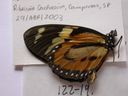
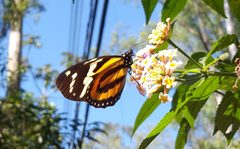
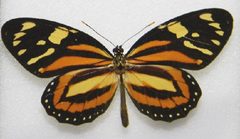
Lycorea halia is a nymphalid in the Danainae , found from Peru through Central America to the Caribbean and Mexico, with occasional strays reaching Texas. It inhabits rainforest environments and has a wingspan of 95–108 mm. The exhibits aposematic coloration typical of milkweed butterflies and has been documented feeding on bird droppings as .
Pronunciation
How to pronounce Lycorea halia: /lɪˈkɔːriə ˈheɪliə/
These audio files are automatically generated. While they are not always 100% accurate, they are a good starting point.
Identification
Distinguished from similar milkweed butterflies by geographic range and specific wing pattern details. The combination of large size (95–108 mm wingspan), tropical rainforest , and distribution from Peru to Mexico helps separate it from related Danainae . variation exists across its range, with L. h. atergatis covering Mexico to Venezuela and Colombia, and L. h. cleobaea in the Antilles.
Images
Habitat
Rainforest. The is associated with tropical forest environments where larval plants occur.
Distribution
Native range extends from Peru through Central America to the Caribbean and Mexico. Strays have been documented as far north as Texas, USA. show regional variation: L. h. halia in Suriname and French Guiana; L. h. cleobaea in the Antilles and Dominican Republic; L. h. atergatis from Mexico to Venezuela and Colombia; L. h. pales in Peru and Brazil (Acre); L. h. demeter in Cuba; additional subspecies in Brazil (Amazonas, Minas Gerais, Rio de Janeiro, Bahia), Ecuador, and Trinidad.
Diet
feed on bird droppings. Larvae feed on Carica papaya (papaya), Ficus carica (common fig), Asclepias curassavica (tropical milkweed), and Jacaratia .
Host Associations
- Carica papaya - larval food plant
- Ficus carica - larval food plant
- Asclepias curassavica - larval food plant
- Jacaratia - larval food plant
Ecological Role
As a Danainae , larvae sequester secondary compounds from plants (particularly Asclepias and related ), making unpalatable to . This contributes to Müllerian mimicry complexes in tropical butterfly .
Similar Taxa
- Other Danainae speciesShare aposematic coloration and characteristics; distinguished by specific wing patterns, size, and geographic distribution.
More Details
Subspecies diversity
The exhibits considerable subspecific variation across its broad Neotropical range, with at least 11 named showing geographic partitioning from the Caribbean through Amazonia to the Andes.