
Boloria kriemhild
(Strecker, 1879)
Relict Fritillary
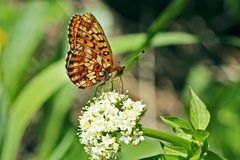
Boloria kriemhild, the relict fritillary, is a North American in the Nymphalidae. It is a grassland-associated fritillary within the Boloria, which includes other species such as the silver-bordered fritillary (B. selene) and small pearl-bordered fritillary (B. selene). The species has been recorded in 212 iNaturalist observations. Its "relict" suggests association with remnant or isolated , though specific ecological details remain limited in published sources.
Pronunciation
How to pronounce Boloria kriemhild: /boʊˈlɔːriə ˈkriːmhɪld/
These audio files are automatically generated. While they are not always 100% accurate, they are a good starting point.
Identification
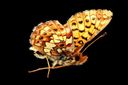
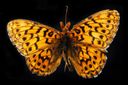
Boloria kriemhild can be distinguished from other Boloria by its North American distribution, as such as Boloria selene (silver-bordered fritillary) and Boloria euphrosyne (pearl-bordered fritillary) are primarily Palearctic. Within its range, it may be confused with other North American fritillaries in the Boloria, Boloria (now sometimes classified under Clossiana), and Speyeria. Precise identification characters including wing pattern, size, and genitalia require examination and are not well-documented in general sources.
Images
Habitat
Associated with grassland in North America. Related Boloria typically inhabit moist meadows, woodland edges, and tundra environments, but specific habitat requirements for B. kriemhild are not well-documented.
Distribution
North America. Specific range details within this region are limited in available sources.
Similar Taxa
- Boloria seleneSilver-bordered fritillary; similar in appearance and but primarily Palearctic in distribution, overlapping minimally or not at all with B. kriemhild
- Boloria euphrosynePearl-bordered fritillary; Palearctic with similar preferences but different geographic range
- Speyeria speciesGreater fritillaries; larger North American fritillaries that may co-occur and require careful distinction
More Details
Taxonomic Note
Originally described as kriemhild by Strecker in 1879, later transferred to Boloria. The basionym reflects historical classification within the broader fritillary group.
Research Context
Boloria , including closely related , have been used as in grassland management studies in the Northern Great Plains, though B. kriemhild specifically is not documented in these studies.
Sources and further reading
- BugGuide
- Wikipedia
- GBIF taxonomy match
- iNaturalist taxon
- NCBI Taxonomy
- Funding from ScottishPower Foundation helps to restore vital habitat to encourage thriving natural ecosystem - Buglife Blog - Buglife
- Do Managed Burns in Grasslands Benefit Butterflies?
- An Evening at Silent Valley - Buglife Blog - Buglife