
Callicorini
Eighty-eights and Allies
Genus Guides
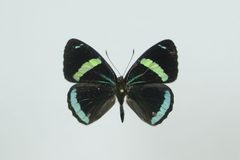
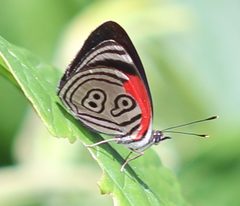
2Callicorini is a tribe of nymphalid butterflies within the Biblidinae, commonly known as "eighty-eights and allies" due to distinctive wing patterns resembling the numerals "88" in some . The tribe includes the Perisama, a species-rich group predominantly restricted to Neotropical cloud forests in the Andes, as well as Diaethria and related genera. Phylogenetic studies indicate Miocene divergence between major lineages, with subsequent radiation correlated to Andean orogeny. Members exhibit diverse wing color patterns, though these have proven less geographically stable than historically assumed.
Pronunciation
How to pronounce Callicorini: /ˌkælɪˈkɔːrɪnaɪ/
These audio files are automatically generated. While they are not always 100% accurate, they are a good starting point.
Identification
The tribe is characterized by reduced forelegs typical of Nymphalidae. Male genitalia serve as the most reliable taxonomic character for -level identification within constituent such as Perisama, superseding wing colour patterns which show considerable geographic variation. Some species display conspicuous wing patterns with contrasting bands or spots; the "eighty-eights" refers to bold markings on the hindwing underside in certain Diaethria species.
Images
Habitat
Predominantly Neotropical cloud forests, especially in Andean regions. Associated with mid- to high-elevation montane .
Distribution
Neotropical region, with strongest representation in the Andes.
Similar Taxa
- LimenitidinaeHistorically merged with Biblidinae (including Callicorini) but now recognized as a distinct lineage based on phylogenetic evidence.
More Details
Phylogenetic relationships
The Perisama, core to this tribe, was recovered as monophyletic only after inclusion of Orophila (now recognized as polyphyletic) and Mesotaenia. Two main clades exist within Perisama: one comprising P. bomplandii and P. oppelii, the other containing all remaining .
Evolutionary timing
Divergence between Perisama and its sister Diaethria is estimated to the Miocene, with the main Perisama radiation occurring from the late Pliocene through the Pleistocene and into the Holocene, coinciding with the final phases of Andean uplift.
Taxonomic revision
Comprehensive sampling of Perisama revealed that wing colour patterns are less geographically stable than previously considered, leading to synonymization of several formerly recognized .