
Diaethria
Billberg, 1820
eighty-eight butterflies
Species Guides
1- Diaethria clymena(Cramer's eighty-eight)
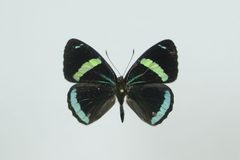
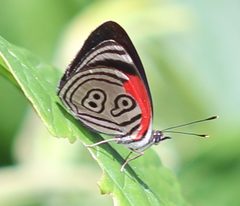
Diaethria is a of brush-footed butterflies in the Biblidinae, distributed across the Neotropics from Mexico to Paraguay. The genus is renowned for distinctive hindwing patterns that resemble the numerals "88" or "89," formed by black dots surrounded by concentric white and black lines. are vividly colored with aposematic black, white, and red wing patterns. The genus comprises approximately twelve described , including well-known such as D. clymena and D. anna.
Pronunciation
How to pronounce Diaethria: /daɪˈiːθriə/
These audio files are automatically generated. While they are not always 100% accurate, they are a good starting point.
Identification
The Diaethria is distinguished from related genera Callicore and Perisama by the specific configuration of hindwing markings: black dots surrounded by concentric white and black lines forming "88" or "89" patterns. display aposematic coloration with bold black, white, and red patterns on wings. is present: females are slightly duller with reduced basal blue flush on the forewing and absent blue on the hindwing.
Images
Habitat
Most occur in montane or submontane of Central America, the Andes, and the Amazon Basin. Humid forests, forest edges, and streams. One species (D. candrena) occupies southernmost range in humid forests at approximately 950 m elevation in Paraná, Brazil.
Distribution
, ranging from Mexico to Paraguay; northern limit extends to Texas, USA; southern limit reaches Tierra del Fuego, Argentina.
Diet
Obligate herbivory on Sapindaceae. Larvae feed on climbing vines including Allophylus puberulus, A. edulis, Serjania, and Paullinia.
Host Associations
- Allophylus puberulus - obligate larval plantfield and laboratory confirmed for D. candrena
- Allophylus edulis - occasional larval plantfield and laboratory confirmed for D. candrena
- Serjania - larval plant-level records for Diaethria
- Paullinia - larval plant-level records for Diaethria
Life Cycle
(~5 days) → first instar (~5 days, builds chains) → second instar (~5 days, builds frass chains) → third instar (~6 days, scoli present) → fourth instar (~6 days) → fifth instar (~10 days including ~1 day ) → pupa (~12 days). Total developmental time approximately 43 days under laboratory conditions for D. candrena candrena. Pupae are green with two small lateral on head, positioned horizontally on upper leaf surface.
Behavior
First and second instar larvae construct chains with silk and fecal pellets on leaf tips, resting on these chains with toward leaf margin. Third to fifth instar larvae rest with head toward petiole and against leaf surface. Later instar larvae move head capsule scoli sideways with up and down movements when disturbed. Fifth instar larvae may abandon plant to seek site. Pupae wobble vigorously when disturbed. Male engage in mud-puddling , strongly attracted to urine-soaked sand.
Ecological Role
Larval herbivory on Sapindaceae; aposematic coloration suggests chemical defense against .
Human Relevance
Popular among enthusiasts and photographers due to distinctive "88" wing patterns. Subject of mitochondrial studies for phylogenetic research.
Similar Taxa
- CallicoreAlso called eighty-eights and shares aposematic coloration, but differs in hindwing pattern configuration
- PerisamaAlso called eighty-eights with similar overall appearance, but hindwing markings differ in pattern structure
Sources and further reading
- BugGuide
- Wikipedia
- GBIF taxonomy match
- iNaturalist taxon
- NCBI Taxonomy
- Catalogue of Life
- Diaethria-marchallii - Entomology Today
- Biology and External Morphology of Immature Stages of the Butterfly,Diaethria candrena candrena
- The complete mitochondrial genome of the smudged eighty-eight butterfly Diaethria gabaza eupepla (Salvin & Godman, 1868) (Insecta: Lepidoptera: Nymphalidae).