
Diaethria clymena
(Cramer, 1775)
Cramer's eighty-eight, Widespread Eighty-eight
Diaethria clymena, commonly known as Cramer's eighty-eight or Widespread Eighty-eight, is a small in the Nymphalidae. It was described by Pieter Cramer in 1775 and occurs across a broad Neotropical range from Mexico through Central America to South America. The is recognized by distinctive wing patterns and has been documented in at least 13 . Its larvae feed on specific plants in the Trema and Theobroma.

Pronunciation
How to pronounce Diaethria clymena: /daɪˈiːθriə ˈklaɪmɪnə/
These audio files are automatically generated. While they are not always 100% accurate, they are a good starting point.
Identification
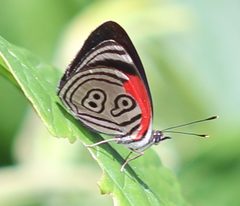
The "88" or "89" marking on the hindwing is diagnostic for the Diaethria; D. clymena is distinguished from primarily by geographic range and subtle differences in the shape and placement of the white patch and black spots. D. anna (Anna's eighty-eight) overlaps in parts of Mexico and Central America but tends to have more rounded white patches. D. euclides and other require examination of genitalia or detailed wing pattern analysis for certain identification. identification relies on geographic provenance and minor pattern variations.
Images
Appearance
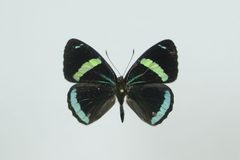
Wingspan 30–40 mm. Upper wing surfaces predominantly black with iridescent blue or green metallic bands. Hindwings feature a striking pattern: a broad black border enclosing a white patch containing two black circular spots, creating the characteristic "88" or "89" numeral appearance that gives the group its . Undersides typically duller, with cryptic brown and gray patterns.
Habitat
Occurs in tropical and subtropical forested environments from lowland rainforests to mid-elevation cloud forests. Observed at elevations from near sea level to approximately 2100 meters. Associated with forest edges, secondary growth, and areas where plants Trema and Theobroma are present.
Distribution
Neotropical. Range extends from Mexico (southern regions) through Central America (Guatemala, Belize, Honduras, Nicaragua, Rica, Panama) to South America: Colombia, Venezuela, Trinidad, Ecuador, Peru, Bolivia, Brazil (Amazonas, Rio de Janeiro, São Paulo, Rio Grande do Sul, Santa Catarina, Pará), Paraguay, and Guyana.
Seasonality
active year-round in equatorial regions; activity peaks vary locally with wet and dry seasons. No specific or migratory documented.
Diet
Larvae feed on leaves of Trema lamarckiana, Trema micrantha ( Cannabaceae), and Theobroma (family Malvaceae). feeding habits not explicitly documented in sources; presumed to feed on rotting fruit, tree sap, and other non-floral resources like .
Host Associations
- Trema lamarckiana - larval food plantCannabaceae
- Trema micrantha - larval food plantCannabaceae
- Theobroma - larval food plantMalvaceae; includes cacao
Life Cycle
Complete . laid on plant leaves. Larvae feed externally on foliage. presumably occurs on or near host plants. Multiple per year where climate permits.
Behavior
often perch on leaf undersides with wings closed, displaying cryptic underside patterns. When disturbed, may flash bright upperwing patterns. described as rapid and erratic, typical of small biblidines. at rotting fruit and sap flows have been observed in and likely occur in this .
Ecological Role
Larvae function as folivores on their plants. may contribute to nutrient cycling through feeding on decaying organic matter. Potential prey for birds, spiders, and other ; the conspicuous wing patterns may serve in deflection or startle displays.
Human Relevance
Popular among enthusiasts and photographers due to distinctive "88" wing pattern. Occasionally referenced in ecotourism materials for Neotropical butterfly-watching. No known agricultural significance; larvae feed on non-cultivated Trema and wild Theobroma rather than commercial cacao.
Similar Taxa
- Diaethria annaOverlaps geographically in Mexico and Central America; differs in white patch shape and spot placement on hindwing
- Diaethria euclidesSouth American with similar pattern; requires detailed examination or geographic separation for identification
- Diaethria phlogeaAnother "eighty-eight" with comparable markings; subtle differences in pattern and distribution
More Details
Subspecies
At least 13 named recognized, varying primarily in minor wing pattern elements and geographic distribution: D. c. aurelia, D. c. beleses (Panama), D. c. bourcieri (Ecuador), D. c. clymena (Guyana, Brazil Amazonas), D. c. colombiana (Colombia), D. c. consobrina (Colombia, Venezuela), D. c. dodone (Colombia), D. c. janeira (Brazil: Rio de Janeiro, São Paulo; Paraguay), D. c. juani (Venezuela, Trinidad), D. c. marchalii (Nicaragua to Colombia), D. c. meridionalis (Brazil: Rio Grande do Sul, Santa Catarina), D. c. peruviana (Peru, Bolivia, Ecuador), D. c. seropina (Brazil: Pará)