
Mestra amymone
(Ménétriés, 1857)
Common Mestra
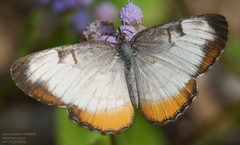
Mestra amymone, known as the Common Mestra, is a nymphalid ranging from the southern United States through Central America to South America. It is the most widespread species in the Mestra, which contains only two or three recognized species. The species was originally described as Cystineura amymone by Ménétriés in 1857. are frequently observed in disturbed and along forest edges.
Pronunciation
How to pronounce Mestra amymone: /ˈmɛstra ˈæmɪmoʊni/
These audio files are automatically generated. While they are not always 100% accurate, they are a good starting point.
Identification
Distinguished from the similar Jamaican Mestra (Mestra dorcas) by geographic range—M. amymone occurs in mainland North and South America while M. dorcas is restricted to Jamaica and possibly other Caribbean islands. M. amymone tends to have more prominent and consistent pale markings on the hindwing. Separated from other brown nymphalids by the combination of angular wing margins, small forewing eyespot, and the distinctive pale band on the hindwing underside. The Common Mestra lacks the tail-like projections found in satyrs and some other brown butterflies.
Images
Habitat
Occurs in open and disturbed including forest edges, clearings, secondary growth, scrublands, and along watercourses. Often found in tropical and subtropical lowlands. Tolerates anthropogenic disturbance and can be common in agricultural areas and urban periphery with remaining vegetation.
Distribution
Ranges from southern Texas and Arizona in the United States south through Mexico, Central America, and into South America including Colombia, Venezuela, and Ecuador. Present throughout the Caribbean lowlands and into suitable at moderate elevations.
Seasonality
are active year-round in tropical portions of the range. In the northern parts of the range (southern United States), adults are most common from late spring through fall, with peak activity in summer months. Multiple occur annually where conditions permit.
Diet
Larvae feed on of Tragia (Euphorbiaceae), a of flowering plants. feed on rotting fruit, , and other decaying organic matter; rarely observed visiting flowers.
Host Associations
- Tragia - larval food plant of Euphorbiaceae; specific used vary by region
Life Cycle
Complete with four stages: , larva, pupa, and . Larvae are green with branching spines and feed on Tragia leaves. occurs on the plant or nearby vegetation. Development time varies with temperature; multiple per year in favorable climates.
Behavior
often perch with wings closed, displaying the cryptic underside. When disturbed, they may fly short distances before settling again. Males perch on vegetation to await females. Adults frequently aggregate at rotting fruit, sap flows, and other food sources. is relatively slow and fluttering, usually close to the ground.
Ecological Role
Larvae function as herbivores on Tragia . contribute to nutrient cycling as consumers of decaying organic matter. Serves as prey for birds, spiders, and other . May facilitate decomposition through feeding activities at carrion and fruit falls.
Human Relevance
Occasionally encountered in gardens and natural history observations. Not considered an agricultural pest. Provides ecological indicator value for disturbed quality in tropical regions.
Similar Taxa
- Mestra dorcasJamaican Mestra; restricted to Jamaica and possibly other Caribbean islands, with slightly reduced pale markings; distribution is primary distinguishing feature
- Hermeuptychia hermybiusSatyr with similar brown coloration and eyespots, but has rounded wing margins and tail-like projection on hindwing; prefers shadier forest
- Junonia coeniaCommon Buckeye; larger with more prominent and colorful eyespots including orange and blue rings; more robust build and faster
More Details
Taxonomic Note
The Mestra contains only two widely accepted : M. amymone and M. dorcas. A third species, M. cana from St. Lucia, is of uncertain validity and may represent a misidentification or local variant.
Etymology
The specific epithet amymone refers to Amymone, a figure from Greek mythology, one of the Danaïdes.