
Rekoa marius
(Lucas, 1857)
Marius hairstreak
Rekoa marius, known as the Marius , is a Neotropical in the Lycaenidae. exhibit in wing coloration, with males showing dark iridescent blue uppersides and females gray. The ranges from Paraguay to northern Mexico, with occasional strays reaching southern Texas and Arizona. Larvae display complex ecological associations including myrmecophily with carpenter ants and feeding on diverse plants.
Pronunciation
How to pronounce Rekoa marius: /rɛˈkoʊ.a ˈmɑː.ri.əs/
These audio files are automatically generated. While they are not always 100% accurate, they are a good starting point.
Identification
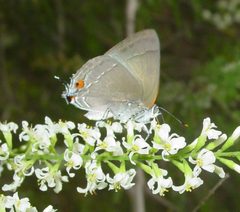
Distinguished from other Rekoa by combination of male dark iridescent blue upperside, female gray upperside, and orange eyespot on hindwing near tail. In southern Texas and Arizona, it is the only Rekoa species present. Similar hairstreaks in the region may be separated by tail and eyespot coloration.
Images
Appearance
Wingspan 22–32 mm. Male upperside dark iridescent blue; female upperside gray. Hindwing bears orange eyespot near tail. Larvae exhibit cryptic polychromatism with variable epithelial coloration.
Habitat
Disturbed tropical areas. Larvae found on inflorescences and foliage of plants including cultivated settings.
Distribution
Paraguay north to Sonora, Mexico. Strays recorded in southern Texas and Arizona. Confirmed larval records from Panama and Brazil (Alagoas).
Seasonality
probably on wing year-round in Mexico. In southern Texas, one period with adults active September to December.
Diet
feed on flower nectar. Larvae feed on flower buds (all instars); final instar additionally consumes green and ripe fruits. Recorded plants include Acalyma wilkesiana, Averrhoa carambola, legumes, and malpighias.
Host Associations
- Acalyma wilkesiana - plantLarvae found on inflorescences and foliage
- Averrhoa carambola - plantLarvae feed on flower buds and fruits; first record for this
- legumes - plantLarval food plant
- malpighias - plantLarval food plant
- Camponotus lindigi - mutualismCarpenter ants tend larvae; myrmecophilic association with tending preferences influenced by larval feeding
- Tenuipetiolus sp. - Eurytomid attacks pupal stages; first report of lepidopteran for this
Life Cycle
deposited on flower buds, inflorescences, and peduncles near flowers. Larvae pass through multiple instars, with final instar expanding diet to include fruits. occurs with egress holes sometimes present in pupae.
Behavior
Larvae exhibit myrmecophily, forming mutualistic associations with carpenter ants. tending is influenced by larval feeding activity. Larvae display cryptic polychromatism, with epithelial color changes serving as protective strategy.
Ecological Role
Herbivore of reproductive structures and fruits of plants. Prey for . Participant in mutualistic -plant-herbivore interactions.
Human Relevance
Potential model organism for studying physiological mechanisms of oxalic acid , given plants in Oxalidaceae. Occasional stray into southern United States may attract observers.
Similar Taxa
- Other Rekoa speciesR. marius distinguished by male iridescent blue coloration and geographic distribution; other in have different color patterns and ranges
- Other Theclinae hairstreaksOrange hindwing eyespot near tail and specific tail help distinguish R. marius from sympatric
More Details
Oxalic acid tolerance
Association with Oxalidaceae (Averrhoa carambola) suggests potential physiological to oxalic acid, offering research opportunities
Taxonomic history
Originally described as Thecla marius by Lucas in 1857; later transferred to Rekoa
Sources and further reading
- BugGuide
- Wikipedia
- GBIF taxonomy match
- iNaturalist taxon
- NCBI Taxonomy
- Bohart Museum Receives Collection of More than 50,000 Aculeate Wasp Specimens | Bug Squad
- Helping the Bohart Museum of Entomology | Bug Squad
- Supporting the Bohart Museum | Bug Squad
- Bug Squad
- New Research Collection Targets Insect Pests of Pulse Crops
- pea weevil - Bruchus pisorum - Entomology Today
- Observaciones biológicas de larvas y pupas de Rekoa marius (Lucas) (Lepidoptera: Lycaenidae) en Panamá
- A taste for fruit: first record of Rekoa marius (Lucas, 1857) (Lepidoptera: Lycaenidae: Eumaeini) on Averrhoa carambola L. (Oxalidales: Oxalidaceae)