
Erora laeta
(Edwards, 1862)
Early Hairstreak
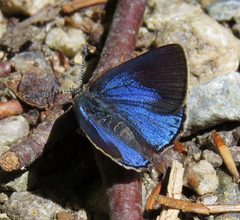
Erora laeta, commonly known as the early , is a small in the Lycaenidae. It occurs in deciduous and mixed woodlands of eastern North America. The is notable for its early spring and specialized association with American beech as a larval . have a wingspan of 21–24 mm.
Pronunciation
How to pronounce Erora laeta: /ɛˈrɔːrə ˈlaɪtə/
These audio files are automatically generated. While they are not always 100% accurate, they are a good starting point.
Identification
Distinguished from other hairstreaks by early season (March–May in most of range). Combination of small size, blue iridescent upperwing, and single thin hindwing tail separates it from Satyrium and other Theclinae . pattern of fine gray striations with orange marginal spots differs from spring azure (Celastrina ladon), which lacks tail and has more uniform underside.
Images
Appearance
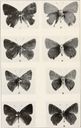
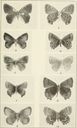
Small with wingspan 21–24 mm. wing surfaces are dark with iridescent blue scaling. surfaces display characteristic pattern with thin, hair-like tail projection on hindwing. Underside marked with fine striations and small dark spots.
Habitat
Deciduous and mixed woodlands, particularly those containing American beech. Occupies mature forest with closed and shaded understory conditions.
Distribution
Eastern Canada and eastern United States. Documented from Ontario and Quebec south through New England, mid-Atlantic states, and Appalachian region to northern Georgia.
Seasonality
active early spring, typically March through May depending on latitude. Single brooded; period coincides with American beech flowering.
Diet
Larvae feed on leaves and fruits of American beech (Fagus grandifolia). Possible secondary use of beaked hazelnut (Corylus cornuta) reported but requires confirmation. feeding habits not documented in sources.
Host Associations
- Fagus grandifolia - larval Primary ; larvae consume leaves and fruits
- Corylus cornuta - possible larval Association reported but not conclusively established
Life Cycle
Complete with , larva, pupa, and stages. Larvae develop on American beech foliage and fruits. site undocumented. stage not specified in available sources.
Ecological Role
Larval herbivore on American beech; contributes to nutrient cycling in deciduous forest . role in pollination not documented.
Similar Taxa
- Satyrium spp.Other hairstreaks in same region; differ in later season, larger size, and more complex patterns
- Celastrina ladonSpring azure overlaps in and season; lacks hindwing tail and has more uniform coloration
More Details
Taxonomic History
Originally described as Thecla laeta by Edwards in 1862; later transferred to Erora.
Conservation Status
Not formally assessed; appears secure within core range but potentially vulnerable to loss of mature beech-dominated forests.