
Callophrys johnsoni
(Skinner, 1904)
Johnson's Hairstreak
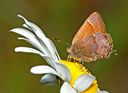
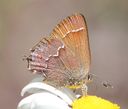
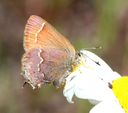
Callophrys johnsoni, commonly known as Johnson's , is a small in the Lycaenidae. It occurs in coniferous forests of western North America from British Columbia to central California. The has a highly specialized larval diet, feeding exclusively on dwarf mistletoes (Arceuthobium species). are active in late spring and early summer, with a single per year.
Pronunciation
How to pronounce Callophrys johnsoni: /kəˈlɒfrɪs ˈdʒɑnsəni/
These audio files are automatically generated. While they are not always 100% accurate, they are a good starting point.
Identification
Distinguished from other western hairstreaks by its association with coniferous forests and dwarf mistletoe plants. The combination of small size (25–30 mm wingspan), single in late spring to early summer, and specific requirements helps separate it from similar such as Callophrys affinis (Western Green Hairstreak) and Callophrys gryneus (Juniper Hairstreak), which occur in different habitats or have different periods.
Images
Appearance
Small with wingspan of 25–30 mm. Upper wing surfaces are typically brown or grayish with subtle markings. Undersides of hindwings display fine, hair-like streaks characteristic of butterflies, often with a thin tail-like projection on the hindwing margin. Overall coloration provides camouflage against coniferous forest backgrounds.
Habitat
Coniferous forests. The is closely tied to forests supporting dwarf mistletoes (Arceuthobium species), which serve as the exclusive larval plants.
Distribution
North America from British Columbia south to central California. Records are concentrated in the Pacific Northwest and California Coast Ranges.
Seasonality
are active from May to July. The has one per year ().
Diet
Larvae are that feed exclusively on dwarf mistletoes, specifically Arceuthobium campylopodum and Arceuthobium tsugense. diet is not documented in available sources.
Host Associations
- Arceuthobium campylopodum - larval plantdwarf mistletoe
- Arceuthobium tsugense - larval plantdwarf mistletoe
Life Cycle
One per year (). emerge in late spring and early summer (May–July). Larval development occurs on dwarf mistletoe plants. Specific details of -laying, , and stage are not documented in available sources.
Ecological Role
The functions as a herbivore in coniferous forest , with larvae consuming parasitic dwarf mistletoes. This specialized feeding relationship may influence mistletoe in forest .
Similar Taxa
- Callophrys affinisWestern Green Hairstreak; occurs in different and has different period
- Callophrys gryneusJuniper Hairstreak; associated with juniper woodlands rather than coniferous forests with dwarf mistletoe
More Details
Taxonomic History
Originally described as Thecla johnsoni by Skinner in 1904, later transferred to Callophrys.
Conservation Considerations
The highly specialized larval diet on dwarf mistletoes makes this potentially vulnerable to forest management practices that reduce mistletoe , though specific conservation status is not documented.