
Feniseca
Grote, 1869
North American Harvesters, Harvester
Species Guides
1- Feniseca tarquinius(Harvester)
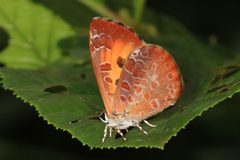
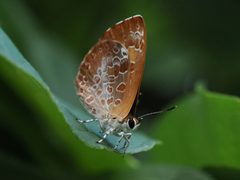
Feniseca is a of butterflies in the Lycaenidae, containing a single , Feniseca tarquinius (the harvester). This genus is notable for representing the only obligate in North America. The larvae feed exclusively on aphids rather than plant material, a highly unusual trait among butterflies. are found in wooded near streams, particularly in association with alders.
Pronunciation
How to pronounce Feniseca: //fɛˈnɪ.sɛ.kə//
These audio files are automatically generated. While they are not always 100% accurate, they are a good starting point.
Identification
Distinguished from other Lycaenidae by its obligate larval . may be recognized by their small size, association with wooded stream near alders, and seasonal activity pattern from early spring through fall. The combination of habitat preference and the unusual of -feeding larvae separates this from superficially similar lycaenids.
Images
Appearance
Wingspan 23–32 mm. have relatively small, rounded wings. The -level appearance characteristics are defined by the single Feniseca tarquinius.
Habitat
Wooded areas near streams, particularly in close association with alders. The specificity is linked to the presence of colonies that serve as larval food sources.
Distribution
Eastern North America. Distribution records include Vermont and other parts of the United States.
Seasonality
Active from early spring until fall. are generally scarce throughout their period.
Diet
Larvae are obligate (), feeding on various including Neoprociphilus, Pemphigus, Prociphilus, and Schizoneura. diet is not specified in available sources.
Host Associations
- Neoprociphilus - prey fed upon by larvae
- Pemphigus - prey fed upon by larvae
- Prociphilus - prey fed upon by larvae
- Schizoneura - prey fed upon by larvae
- Alnus - associatedalders; indicator plant near which occur
Life Cycle
Complete with , larval, pupal, and stages. Specific details of timing and sites are not documented in available sources.
Behavior
Larvae are known to actively prey upon colonies. are described as generally scarce and have been observed from early spring through fall.
Ecological Role
Larvae function as of , potentially providing of these sap-feeding insects in wooded riparian .
Human Relevance
Featured in educational materials about unusual , including children's science literature emphasizing that butterflies can have 'gross' or unexpected natural histories. The serves as an example of carnivory in an otherwise herbivorous group.
Similar Taxa
- Other Lycaenidae generaMost lycaenid butterflies have herbivorous larvae feeding on plants; Feniseca is distinguished by its obligate carnivory and -feeding .
- Carnivorous butterflies in other regionsWhile some other miletine butterflies worldwide are , Feniseca is the only in North America with this trait.
More Details
Taxonomic uniqueness
Feniseca is , containing only the single Feniseca tarquinius. This represents a rare case of a -level with no close relatives in its geographic region.
Conservation status
Described as generally scarce throughout its range, though specific conservation assessments are not documented in available sources.