
Miletinae
harvesters, woolly legs
Genus Guides
1- Feniseca(North American Harvesters)
Miletinae is a of Lycaenidae butterflies distinguished by larvae that are virtually unique among butterflies. and larvae maintain obligate associations with ants. Most feed on Hemiptera prey tended by ants, though some like Liphyra are known to feed on ants themselves. The subfamily is entirely aphytophagous, having lost herbivory across all lineages.
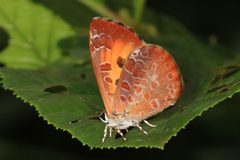
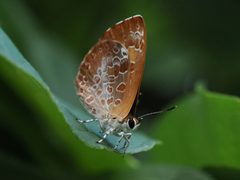
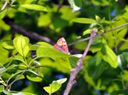
Pronunciation
How to pronounce Miletinae: //ˈmaɪlɪˌtaɪniː//
These audio files are automatically generated. While they are not always 100% accurate, they are a good starting point.
Identification
Miletinae can be distinguished from other Lycaenidae by their association with ants and predatory larval . are small to medium-sized butterflies with reduced or absent functional mouthparts in some . Larvae are typically slug-like, heavily setose (woolly legs), and possess specialized morphological adaptations for living within colonies.
Images
Habitat
occur in diverse including tropical and subtropical forests, forest-savanna mosaics, and sub-montane regions. Many species are associated with specific -hemipteran systems and show strong fidelity to locations where these interactions occur.
Distribution
Afrotropical, Indomalayan, Australasian, East Asian Palearctic, and Nearctic realms. Tribe Miletini occurs in the Indomalayan and Afrotropical realms. Tribe Spalgini spans Indomalayan, Afrotropical, Nearctic, East Asian Palearctic, and Australasian realms. Tribe Lachnocnemini is restricted to the Afrotropical realm. Tribe Liphyrini occurs in Afrotropical, Indomalayan, and Australasian realms.
Diet
Host Associations
- Formicidae - myrmecophilyObligate association; larvae live within colonies
- Hemiptera - Primary prey; includes aphids, coccids, membracids, and psyllids tended by ants
- Aphididae - Common prey item for many
- Coccidae - Scale insects form part of larval diet
- Membracidae - Treehoppers are documented prey
- Psyllidae - Jumping plant lice are documented prey
Life Cycle
Complete with , larval, pupal, and stages. Larvae develop within colonies, often protected by chemical and behavioral adaptations that prevent ant aggression. typically occurs within ant nests. The duration and specifics of developmental stages vary by and are influenced by ant availability and hemipteran prey .
Behavior
Larvae are myrmecophilous, living within colonies where they prey on hemipterans tended by the ants or, in some lineages, on ant directly. Chemical camouflage and behavioral mimicry facilitate integration into ant societies. are often inconspicuous and may remain near ant-hemipteran associations. Some show strong site fidelity.
Ecological Role
Miletinae function as tertiary consumers in -hemipteran , linking ant-tended Hemiptera to higher . Their predatory larvae may regulate hemipteran populations within ant mutualism systems. The obligate myrmecophily represents an evolutionary commitment to ant-mediated resource acquisition.
Human Relevance
Of limited direct economic importance. Some are of conservation concern due to specificity and dependence on intact -hemipteran systems. The is of significant scientific interest for studying evolutionary transitions between herbivory and carnivory, and the evolution of myrmecophily.
Similar Taxa
- TheclinaeBoth are Lycaenidae with myrmecophilous larvae; Theclinae larvae are primarily herbivorous with facultative associations, whereas Miletinae are obligate and myrmecophiles
- AphnaeinaeSome Aphnaeinae have associations, but retain herbivorous larvae; Miletinae are distinguished by complete loss of herbivory and obligate carnivory
- LiphyrinaeFormerly treated as a separate , now included within Miletinae as tribe Liphyrini based on molecular and morphological evidence
Sources and further reading
- BugGuide
- Wikipedia
- iNaturalist taxon
- NCBI Taxonomy
- Catalogue of Life
- Papilionoidea: Lycaenidae: Aphnaeinae, Lycaeninae, Miletinae, Polyommatinae, Poritiinae, Theclinae
- When caterpillars attack: Biogeography and life history evolution of the Miletinae (Lepidoptera: Lycaenidae)
- <i>Aslauga larseni<i> (Lepidoptera: Lycaenidae: Miletinae), a unique new species from the Nimba Mountains, Liberia
- The biology of carnivorous butterfly larvae (Lepidoptera: Lycaenidae: Miletinae: Miletini) and their ant‐tended hemipteran prey in Thailand and the Philippines
- Observations on the life history of the Southern Pied Woolly Legs, <i>Lachnocnema laches<i> Fabricius, 1793 (Lycaenidae: Miletinae) in the Mpumalanga lowveld