
Lycaena gorgon
(Boisduval, 1852)
gorgon copper
Lycaena gorgon, commonly known as the gorgon , is a in the Lycaenidae native to western North America. It is distinguished by in wing coloration and has a single . The species is closely associated with its plant Eriogonum nudum and inhabits foothill environments including chaparral, woodland, and canyon . Its distribution is centered in California with records extending into adjacent regions.
Pronunciation
How to pronounce Lycaena gorgon: /laɪˈsiːnə ˈɡɔːrɡən/
These audio files are automatically generated. While they are not always 100% accurate, they are a good starting point.
Identification
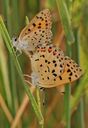
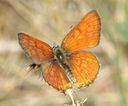
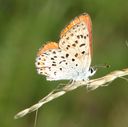
Males distinguished from other Lycaena by brown upperside with purple sheen; females by brown ground color with yellow markings and black spots. Underside pattern of whitish ground with black spots and reddish-orange hindwing marginal spots provides additional diagnostic characters. Similar to other copper butterflies but combination of and specific spot pattern distinguishes it from .
Images
Appearance
Medium-sized with pronounced . Male upperside: brown with purple iridescent sheen. Female upperside: brown with yellow markings and black spots. Underside of wings (both sexes): whitish ground color with black spots; hindwing with reddish-orange submarginal spots. Wingspan and precise measurements not documented in available sources.
Habitat
Foothill environments including chaparral, woodland, and canyon . Associated with open, dry slopes and ridges where plant occurs. Elevation range not explicitly documented but typical of California foothill zone.
Distribution
North America, primarily California. Records indicate presence in foothill regions of the state; precise northern and southern limits not detailed in available sources.
Seasonality
Single , active March through July. period corresponds to spring and early summer in Mediterranean climate zone.
Diet
Larval : Eriogonum nudum (Polygonaceae). nectar sources include flowers of host plant plus milkweed (Asclepias spp.) and Eriophyllum lanatum.
Host Associations
- Eriogonum nudum - larval plant also feed on flowers of this
- Asclepias spp. - nectar sourceMilkweed flowers
- Eriophyllum lanatum - nectar source
Life Cycle
Single brooded (). Complete with , larva, pupa, and stages. Specific details of egg deposition, larval instars, site, and stage not documented in available sources.
Behavior
observed feeding on flowers. Males likely perch to seek females as in related , though specific mate-location not documented. No migratory behavior reported.
Ecological Role
of native wildflowers including Eriogonum nudum, milkweed, and Eriophyllum lanatum. Larval herbivore on E. nudum. Specific interactions with , , or other functions not documented.
Human Relevance
Subject of monitoring and conservation interest. No documented economic importance or pest status. Collected for scientific study and observation.
Similar Taxa
- Other Lycaena speciesSimilar ; distinguished by specific wing pattern elements and coloration differences in both sexes
- Lycaena phlaeas (Small Copper)Overlapping distribution in North America; L. phlaeas has orange- upperside in males, not purple-brown, and different underside pattern
More Details
Subspecies
Four recognized: L. g. gorgon (nominate), L. g. dorothea, L. g. jacquelineae, and L. g. micropunctata (all described by J. Emmel & Pratt in T. Emmel, 1998). Geographic ranges and distinguishing characters of subspecies not detailed in available sources.
Taxonomic authority
Described by Jean Baptiste Boisduval in 1852. MONA/Hodges number 4255.