
Lycaena dione
Scudder, 1868
grey copper, great copper
Lycaena dione, commonly known as the grey or great copper, is a in the Lycaenidae. First described by Samuel Hubbard Scudder in 1868, this species is distributed across central North America from southern Canada to Texas. are active from mid-June through July or August, with a wingspan ranging from 24 to 38 mm. The species is sometimes treated as a of Lycaena xanthoides, reflecting ongoing taxonomic debate.
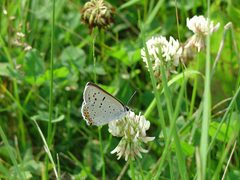
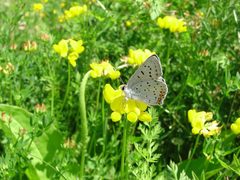
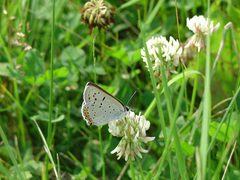
Pronunciation
How to pronounce Lycaena dione: /lɪˈsiːnə ˈdaɪoʊni/
These audio files are automatically generated. While they are not always 100% accurate, they are a good starting point.
Identification
Distinguished from other North American copper butterflies by its greyish coloration and distribution in the Great Plains region. May be difficult to separate from Lycaena xanthoides, with which it has been synonymized by some authorities; the two require careful examination of genitalia or molecular analysis for definitive identification.
Images
Appearance
Wingspan 24–38 mm. exhibit coloration typical of the , with greyish tones distinguishing this . Specific wing pattern details are not well documented in available sources.
Habitat
Open grassland and prairie , particularly in association with its larval plants. Occurs in agricultural landscapes and natural grasslands where Rumex grow.
Distribution
North America: southern Prairie provinces of Canada (Alberta, Saskatchewan, Manitoba), western Ontario, south to Texas, east to Illinois and Missouri. Disjunct in southern British Columbia. Remnant population documented in Willamette Valley, Oregon as of 2004.
Seasonality
active from mid-June to July or August. Single brooded or with limited second in southern portions of range.
Diet
feed on nectar of Cirsium (thistles), Medicago sativa (alfalfa), Grindelia (gumweeds), and Melilotus species (sweet clovers). Larvae feed on Rumex salicifolius (willow dock), Rumex crispus (curly dock), and Rumex occidentalis (western dock).
Host Associations
- Rumex salicifolius - larval willow dock
- Rumex crispus - larval curly dock
- Rumex occidentalis - larval western dock
- Cirsium - nectar sourcethistles
- Medicago sativa - nectar sourcealfalfa
- Grindelia - nectar sourcegumweeds
- Melilotus - nectar sourcesweet clovers
Life Cycle
Complete with , larva, pupa, and stages. Larvae feed on Rumex . Specific details of site and stage not documented in available sources.
Ecological Role
function as when nectaring on flowers. Larvae are herbivores on dock (Rumex). Serves as an for grassland health in prairie .
Human Relevance
Subject to long-term monitoring as part of conservation efforts. Listed among declining butterfly in western North American studies. Agricultural intensification and loss in prairie regions have been identified as threats.
Similar Taxa
- Lycaena xanthoidesSometimes treated as ; requires careful examination for separation
- Lycaena phlaeasSimilar coloration but smaller size and different distribution
More Details
Taxonomic status
The is sometimes treated as a of Lycaena xanthoides, reflecting historical taxonomic uncertainty. The two may represent a requiring further study.
Conservation status
Documented as declining in parts of its range. A remnant in Oregon's Willamette Valley was noted in 2004, suggesting potential range contraction.
Sources and further reading
- BugGuide
- Wikipedia
- GBIF taxonomy match
- Mary Louise Flint's Article in The Acorn: 'Butterflies in Decline' | Bug Squad
- 'Climate Change' May Be a Key Factor in Declining Butterfly Populations | Bug Squad
- Bug Eric: Breaking: Mexican Silverspot Butterfly Sighted in Colorado
- Over a century later, the mystery of the Alfred Wallace’s butterfly is solved | Blog
- Grassland butterflies: important indicators of the state of nature