
Heliopetes macaira
(Reakirt, 1866)
Turk's-cap White-Skipper
Heliopetes macaira is a small in the Hesperiidae, ranging from southern Texas through Central America to Paraguay. It is closely associated with Turk's-cap (Malvaviscus drummondii), which serves as its larval plant. are active from spring through late autumn in the northern part of its range, with multiple produced annually.

Pronunciation
How to pronounce Heliopetes macaira: /ˌhɛli.oʊˈpiːtiːz məˈkaɪrə/
These audio files are automatically generated. While they are not always 100% accurate, they are a good starting point.
Identification
Small size (32–35 mm wingspan) distinguishes it from larger white skippers. The specific association with Malvaviscus drummondii as a larval helps separate it from similar Heliopetes where host plants differ. H. m. macaira occurs in North and Central America, while H. m. orbigera occurs in Brazil and Bolivia.
Images
Appearance
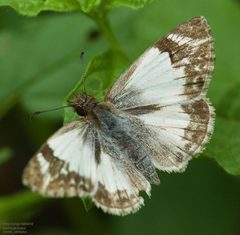
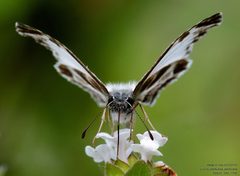
Wingspan 32–35 mm. A small white skipper with relatively plain, pale wings. The refers to its association with Turk's-cap flowers rather than distinctive wing markings.
Habitat
Associated with areas where the larval plant Malvaviscus drummondii grows; this includes woodland edges, scrub, and gardens in subtropical and tropical regions.
Distribution
Southern Texas (USA) south through Mexico, Central America, and into South America to Paraguay. Two recognized with partially distributions: H. m. macaira from Arizona through Central America to Venezuela, and H. m. orbigera in Brazil and Bolivia.
Seasonality
on wing from April to November in southern Texas, with multiple produced. Year-round activity likely in tropical portions of the range, though specific documentation is limited.
Diet
Larvae feed exclusively on Malvaviscus drummondii (Turk's-cap, a mallow plant). feed on flower nectar.
Host Associations
- Malvaviscus drummondii - larval exclusive larval ; of derives from this plant
Life Cycle
Multiple per year in temperate parts of range. Complete with , larval, pupal, and stages. Larvae feed on Malvaviscus drummondii.
Ecological Role
function as while feeding on nectar. Larvae are specialized herbivores on Malvaviscus drummondii.
Human Relevance
Occasionally observed in gardens where Turk's-cap is cultivated. Not considered an agricultural pest.
Similar Taxa
- Other Heliopetes speciesSimilar size and general appearance; distinguished by larval plant associations and subtle wing pattern differences where documented
- Other white skippers (Hesperiidae)Larger exceed 35 mm wingspan; smaller size and specific plant tie help separate H. macaira
More Details
Subspecies
Heliopetes macaira macaira (Reakirt, 1866) — Arizona, Mexico, Guatemala, Panama, Venezuela; Heliopetes macaira orbigera (Mabille, 1877) — Brazil, Bolivia