
Gesta invisus
(Butler & Druce, 1872)
False Duskywing
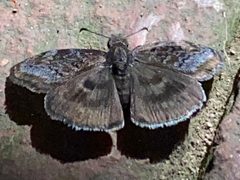
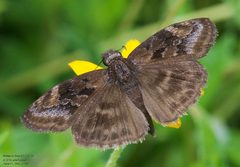
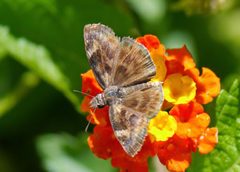
Gesta invisus, commonly known as the false duskywing, is a of spread-wing skipper in the Hesperiidae. It was first described by Arthur Gardiner Butler and Herbert Druce in 1872. The species is distributed across Central and North America. Like other skippers, it exhibits the characteristic rapid, darting pattern typical of the family. The MONA or Hodges number for this species is 3943.
Pronunciation
How to pronounce Gesta invisus: /ˈɡɛs.ta ɪnˈwiː.səs/
These audio files are automatically generated. While they are not always 100% accurate, they are a good starting point.
Identification
The false duskywing can be distinguished from true duskywings ( Erynnis) by subtle differences in wing pattern and , though precise identification often requires examination of genitalia or detailed wing venation. As a spread-wing skipper, it typically rests with wings held partially open rather than folded vertically. The name "invisus" (Latin for "unseen" or "hated") may allude to its cryptic appearance or difficulty of detection. Accurate identification from similar Gesta species and Erynnis duskywings generally requires knowledge or dissection.
Images
Distribution
Central America and North America. Specific countries and range boundaries within this region are not well documented in available sources.
Similar Taxa
- Erynnis spp. (true duskywings)Similar and general appearance; distinguished by wing venation details and genitalia structure
- Gesta gestaClosely related congeneric with which it has been synonymized in some treatments; subtle wing pattern differences separate the
More Details
Taxonomic Notes
The has been treated as a of Gesta gesta (as Gesta gesta invisus) in some classifications, but is currently recognized as a distinct species by most authorities. GBIF lists it as a synonym of Gesta gesta, while iNaturalist and NCBI maintain it as a valid species. The taxonomic instability reflects ongoing revisions within the .
Etymology
The specific epithet "invisus" derives from Latin, meaning "unseen," "hated," or "detested." The origin of this name choice by Butler and Druce in 1872 is not recorded, but may refer to the ' cryptic coloration or its resemblance to other species that makes it difficult to recognize.
Sources and further reading
- BugGuide
- Wikipedia
- GBIF taxonomy match
- iNaturalist taxon
- NCBI Taxonomy
- Catalogue of Life
- The Art of the Ant | Bug Squad
- Got Milk? Got a Question About Tsetse Flies? | Bug Squad
- Bark Beetle Identification: There’s an App for That, Too
- Dicerca pugionata – safe and sound! | Beetles In The Bush
- Bichos Argentinos #6 – Jumping Spider | Beetles In The Bush
- Super Crop Challenge #8 | Beetles In The Bush