
Piruna
Evans, 1955
Species Guides
4- Piruna aea(many-spotted skipperling)
- Piruna haferniki(Chisos Skipperling)
- Piruna pirus(Russet Skipperling)
- Piruna polingii(Four-spotted Skipperling)
Piruna is a of skippers in the Hesperiidae, Heteropterinae. The genus contains approximately 22 described distributed primarily in Mexico and adjacent regions of the southwestern United States. Species were described between 1872 and 1999, with significant taxonomic revisions by Freeman in the 1970s–1990s. The genus is characterized by relatively small size and subtle wing pattern variations among species.
Pronunciation
How to pronounce Piruna: /piˈruːna/
These audio files are automatically generated. While they are not always 100% accurate, they are a good starting point.
Identification
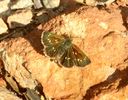
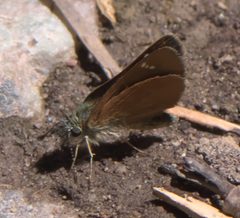
Piruna are small skippers with relatively plain, brownish to grayish wings. Distinguishing individual species requires examination of wing pattern details, particularly the presence and arrangement of small pale spots on the forewings and hindwings, and subtle differences in wing shape. Male genitalia structure has been used in taxonomic descriptions to separate closely related species. The is distinguished from related Heteropterinae genera by combinations of wing venation and genitalic characters.
Images
Habitat
in this occupy montane and foothill in western and southern Mexico, with some range extension into Arizona and New Mexico. Elevational distribution varies by species, with records from approximately 1,000 to 3,000 meters. Habitats include pine-oak woodlands, oak forests, and adjacent grassy clearings.
Distribution
The is to the Nearctic and Neotropical regions, with primary distribution in Mexico. Records extend from the Sierra Madre Occidental and Sierra Madre Oriental southward through the Trans-Mexican Volcanic Belt to Oaxaca. Northern reach southeastern Arizona, southwestern New Mexico, and western Texas in the United States.
Seasonality
periods vary by and elevation. Most species fly during the summer monsoon season (July–September) in Mexico. Lower elevation species may have earlier flight periods beginning in late spring. Specific data are available for only a subset of described species.
Behavior
have been observed visiting flowers for nectar. is rapid and low to the ground, typical of small skippers. Perching on low vegetation has been noted for some .
Ecological Role
function as when visiting flowers. Larval plant relationships are poorly documented; the Heteropterinae is associated with various monocot , but specific host records for Piruna are largely unverified.
Human Relevance
The has no documented economic importance. Some are occasionally encountered by lepidopterists in Mexico and the southwestern United States. Piruna pirus and Piruna polingii are among the more frequently recorded species in regional collections.
Similar Taxa
- HeteropterusBoth belong to Heteropterinae and share similar small size and brownish wing coloration. Heteropterus typically have more pronounced wing markings and different genitalic structure.
- CarterocephalusSimilar small skipper , but Carterocephalus usually display more contrasting orange or yellow wing markings and have different club shapes.
- AmblyscirtesOverlaps in geographic range and preference. Amblyscirtes generally show more distinct wing banding patterns and different male genitalia .
More Details
Taxonomic history
The was established by Evans in 1955, consolidating several previously placed in other genera. Freeman conducted extensive revisions between 1970 and 1991, describing 11 new species. Warren and González described the most recent species, Piruna purepecha, in 1999.
Conservation status
No Piruna have been formally assessed by the IUCN. Several species have restricted ranges in montane Mexico and may be vulnerable to alteration, but data are insufficient for status determination.