
Problema byssus
(Edwards, 1886)
Byssus Skipper, bunchgrass skipper
Problema byssus, commonly known as the Byssus Skipper or bunchgrass skipper, is a medium-sized in the Hesperiidae. The exhibits a disjunct distribution across three North American regions: the Atlantic coastal plain, the Midwestern tallgrass prairie, and localized prairie fragments. Its larvae feed on specific native grasses, particularly eastern gamagrass and big bluestem. The species is of conservation concern, ranked as G3–G4 (rare or locally threatened) by NatureServe, with critically imperiled in Nebraska.
Pronunciation
How to pronounce Problema byssus: /ˈproʊblɛmə ˈbɪsəs/
These audio files are automatically generated. While they are not always 100% accurate, they are a good starting point.
Identification
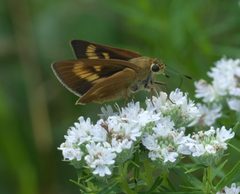
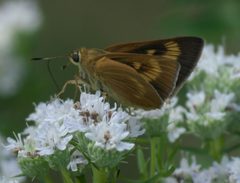
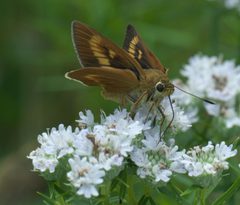
Distinguished from similar skippers by the combination of bright yellow-orange upper wings with black borders, and the band of pale spots on the hindwings. The in hindwing underside coloration—dull yellow in males versus rust-colored in females—provides a useful identification cue. The ' strong association with tallgrass prairie and wetland also aids in field identification.
Images
Habitat
Tallgrass prairies in the Midwest; moist grassy wetlands including marsh edges and wet pine savannas along the Atlantic coastal plain. require -grass clumps for larval development.
Distribution
Disjunct distribution across three North American regions: Atlantic coastal plain from North Carolina south through Florida and Gulf states; Midwestern tallgrass prairie from northern Indiana to Iowa, Missouri, and Kansas; and localized prairie fragments such as southeastern Nebraska.
Seasonality
Midwest: one from June to July. Southeast: two broods from May to September, occasionally extending into October.
Diet
Larvae feed on eastern gamagrass (Tripsacum dactyloides) and big bluestem (Andropogon gerardii). nectar from various wildflowers, including pickerelweed.
Host Associations
- Tripsacum dactyloides - larval food planteastern gamagrass
- Andropogon gerardii - larval food plantbig bluestem
Life Cycle
laid singly on plant leaves. Larvae feed on host grasses while sheltering in silk-tied leaves. occurs in leaf litter within silk cocoons. emerge to feed on nectar and reproduce. One per year in the Midwest, two broods in the Southeast.
Behavior
Larvae construct silk shelters by tying leaves together. are active during daylight hours and visit flowers for nectar.
Ecological Role
of wildflowers through nectar-feeding. Larval herbivore of native prairie grasses. Component of tallgrass prairie and wetland .
Human Relevance
Subject to conservation efforts focused on preserving tallgrass prairie and wetland . in Nebraska are critically imperiled (S1). Fire management must be used cautiously to protect -grass clumps. Not known to be an agricultural pest or beneficial in managed systems.
Similar Taxa
- Other Hesperiidae skippersSimilar general and pattern; distinguished by specific coloration pattern and association
More Details
Conservation Status
NatureServe ranks Problema byssus as G3–G4 (rare or locally threatened). Nebraska are critically imperiled (S1). Conservation measures emphasize preservation and cautious fire management.
Subspecies
Two recognized : Problema byssus byssus and Problema byssus kumskaka (Scudder, 1887).
Sources and further reading
- BugGuide
- Wikipedia
- GBIF taxonomy match
- iNaturalist taxon
- Catalogue of Life
- How Crickets Can "Upcycle" Bad Grain Into Useful Animal Feed
- Naming a Bug After a Droid: The Case of Kaytuesso flavolateralis
- Alfalfa Weevil: New Integrated Pest Management Guide Available
- Bug Eric: Flying Ants
- Bug Eric: The Changing Conversation Around Invasive Species
- Study Confirms Effectiveness of Cheap, Simple Traps for Citizen Science Project