
Polites rhesus
(W.H. Edwards, 1878)
Rhesus Skipper, Plains Gray Skipper
Polites rhesus is a North American in the Hesperiidae. The occurs across the Great Plains and adjacent regions, with a range extending from Texas northward to North Dakota, and sporadically into southern Canada. It is one of numerous grassland skippers whose may be affected by conversion and agricultural intensification, though specific population trends for this species are not well documented.
Pronunciation
How to pronounce Polites rhesus: /pɔˈlaɪtiːz ˈriːsəs/
These audio files are automatically generated. While they are not always 100% accurate, they are a good starting point.
Identification
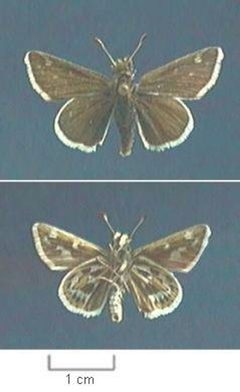
Polites rhesus can be distinguished from similar Polites by its relatively plain grayish-brown wing surfaces with limited patterning. It lacks the more pronounced maculation seen in related species such as Polites sabuleti (Sandhill Skipper). The "plains gray skipper" references this subdued coloration. Accurate identification typically requires examination of wing pattern details and, in some cases, genitalia dissection or molecular analysis.
Images
Habitat
Grassland and prairie , including native tallgrass and shortgrass prairies, as well as adjacent open areas with suitable grasses.
Distribution
North America from Texas north to North Dakota; occurs sporadically and infrequently in southern Canada (Saskatchewan and Alberta). The core range lies within the Great Plains and adjacent regions of the central United States.
Diet
Larvae feed on grasses (Poaceae); specific grass have not been definitively documented in the provided sources.
Similar Taxa
- Polites sabuletiSandhill Skipper shares grassland and overlapping range; differs in wing pattern and grass associations.
- Other Polites speciesMultiple occur in similar and require careful examination of wing pattern and genitalia for reliable identification.
Sources and further reading
- BugGuide
- GBIF taxonomy match
- iNaturalist taxon
- NCBI Taxonomy
- UC Davis Symposium to Target Zika, West Nile and Other Vector-Borne Diseases | Bug Squad
- Zeroing in on the Zika Virus | Bug Squad
- How Far North Will This Mosquito Species Go in California? | Bug Squad
- UC Davis Researcher: What Repellents and Doses Are Best to Prevent Zika Virus | Bug Squad
- UC Davis Zika Symposium: A Crucial Message | Bug Squad
- Where Are All the Butterflies? | Bug Squad