
Polites peckius
(Kirby, 1837)
Peck's Skipper
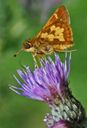
Polites peckius, commonly known as Peck's Skipper, is a North American grass skipper in the Hesperiidae. It is widely distributed across northern and central North America, from British Columbia to Labrador in Canada and throughout most of the northern and central United States. The produces two to three annually and is active from May through October. feed on nectar from flowers including red clover, purple vetch, and thistles, while larvae consume various grasses.
Pronunciation
How to pronounce Polites peckius: /pɔˈlaɪtiːz ˈpɛkiəs/
These audio files are automatically generated. While they are not always 100% accurate, they are a good starting point.
Identification
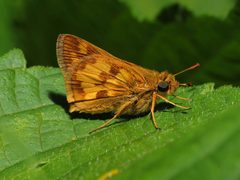
The large straw-colored patch on the hindwing separates P. peckius from other Polites . Males can be identified by the presence of a forewing stigma, absent in females. The combination of small size (19-27 mm wingspan), dark brown and orange coloration, and grass skipper antennal hooks confirms -level placement.
Images
Appearance
have dark brown and yellowish-orange markings. Both sexes display a large straw-colored patch on the surface of the hindwing, a diagnostic feature distinguishing this from other Polites. Males are lighter in color than females and possess a stigma (round or oval mark) on the forewing. The terminate in tiny hooks, characteristic of skippers. Wingspan ranges from 19 to 27 mm.
Habitat
Grassy including meadows, marshes, and roadsides. Occupies open areas with abundant grass cover for larval development and nectar sources for .
Distribution
North America: Canada from British Columbia east to Labrador, north to Cartwright (Labrador), Moar Lake (Ontario), Leaf Rapids (Manitoba), and Hay River area (Alberta). United States: most northern and central states, absent from the west coast.
Seasonality
active May through October. Two to three per year depending on latitude and local climate conditions.
Diet
consume nectar from flowers including red clover (Trifolium pratense), purple vetch (Vicia spp.), and thistles (Cirsium spp.). Larvae feed on rice cutgrass (Leersia oryzoides), bluegrass (Poa spp.), and other grasses.
Host Associations
- red clover - nectar source feeding
- purple vetch - nectar source feeding
- thistles - nectar source feeding
- rice cutgrass - larval larval food plant
- bluegrass - larval larval food plant
Life Cycle
Produces two to three annually. Females lay single . Larvae feed on grasses. stage not explicitly documented in available sources.
Behavior
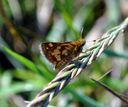
Rests with forewings held open in a V shape and hindwings held horizontally to the side, or with all four wings folded together exposing only surfaces. Males perch in sunny open areas to await receptive females. Courtship occurs throughout the day.
Ecological Role
function as when visiting flowers for nectar. Larvae are herbivores consuming grasses, contributing to nutrient cycling in grassland .
Similar Taxa
- Other Polites speciesDifferentiated by the large straw-colored patch on the hindwing, which is unique to P. peckius within the
- Other grass skippers (Hesperiinae)Antennal hooks and resting posture are shared traits; P. peckius distinguished by specific wing pattern elements