
Oligoria maculata
(Edwards, 1865)
Twin-spot Skipper
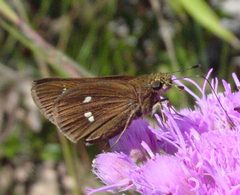
A small with rounded, brown-black wings marked by distinctive transparent spots. fly from spring through late summer, with multiple per year. The is restricted to coastal and near-coastal of the southeastern United States, where larvae feed on grasses and adults visit flowers for nectar.


Pronunciation
How to pronounce Oligoria maculata: /ɒlɪˈɡɔːriə ˌmækjʊˈleɪtə/
These audio files are automatically generated. While they are not always 100% accurate, they are a good starting point.
Identification
The combination of rounded brown-black wings with four transparent spots on the forewing upperside separates this from other southeastern skippers. The three white spots on the pale red-brown underside of the hindwings provide a confirming character. Similar skippers in the region lack this specific spot arrangement or show different wing shapes.
Images
Habitat
Coastal and near-coastal environments including salt marshes, coastal prairies, and adjacent open areas. Associated with grassy vegetation in these settings.
Distribution
Coastal North Carolina south through Florida and west along the Gulf Coast to east Texas. Strays occasionally recorded as far north as Pennsylvania, Maryland, and New Jersey.
Seasonality
active April to September. Two or possibly three per year.
Diet
feed on flower nectar, including Pontederia . Larvae feed on various Poaceae (grass) species.
Life Cycle
Two or possibly three per year. Larvae feed on grasses. emerge in spring and continue through late summer with overlapping .
Behavior
visit flowers for nectar. period extends across warm months with multiple .
Ecological Role
; larval herbivore on grasses.
Similar Taxa
- Other Hesperiidae in coastal SoutheastMay share and general brown coloration; distinguished by transparent spot pattern and hindwing underside markings
- Panoquina speciesSimilar coastal skipper ; differ in wing shape and spot patterns
Sources and further reading
- BugGuide
- Wikipedia
- GBIF taxonomy match
- iNaturalist taxon
- NCBI Taxonomy
- Catalogue of Life
- Be careful around baldfaced hornets, Dolichovespula maculata — Bug of the Week
- An inside look at baldfaced hornets, Dolichovespula maculata — Bug of the Week
- High fiber diets for baldfaced hornets? Nah, construction materials for enlarging nests: Baldfaced hornets, Dolichovespula maculata — Bug of the Week
- What do insects do in winter, Part 2? Tolerating the big chill: Banded woolly bears, Pyrrharctia isabella, field crickets, Gryllus spp., baldfaced hornets, Dolichovespula maculata, and others — Bug of the Week
- Bug Eric: Window-winged Moths
- Spiney, scaley distractions | Beetles In The Bush