
Euphyes arpa
(Boisduval & Le Conte, 1829)
Palmetto Skipper
Euphyes arpa, commonly known as the Palmetto Skipper, is a in the Hesperiidae. The is to the southeastern United States, with its range centered on Florida and extending into adjacent states. It is closely associated with saw palmetto (Serenoa repens) , where larvae feed exclusively on fronds and nectar at flowers. Despite having an abundant food source, the species is declining for reasons that remain unclear, and it has been assessed as vulnerable by NatureServe.
Pronunciation
How to pronounce Euphyes arpa: /ˈjuː.faɪz ˈɑːr.pə/
These audio files are automatically generated. While they are not always 100% accurate, they are a good starting point.
Identification
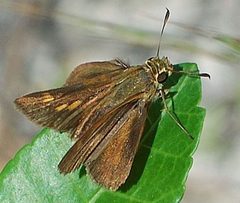
Distinguished from similar skippers by the combination of bright orange and , yellow-orange hindwing underside, and in males, the two-part black stigma patch on the forewing. The association with saw palmetto scrub provides additional context for identification. Females may be confused with other dark skippers but lack the extensive orange markings of males.
Images
Habitat
Lowland palmetto scrub characterized by moist conditions and abundant saw palmetto (Serenoa repens). Specific types include open pine flats and forested scrub/shrub wetlands. The requires subterranean or low-growing palmetto with sufficient to support larval development.
Distribution
Southeastern United States, primarily Florida with adjacent in Georgia, Alabama, and Mississippi. Possibly established as resident only in Florida and Mississippi. The has not been documented in South Carolina despite the 's suggestion.
Seasonality
active from approximately March to November in most of Florida, with multiple per year.
Diet
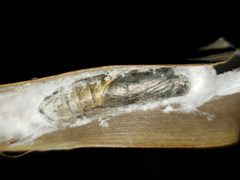
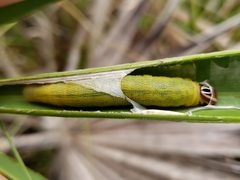
Larvae feed exclusively on fronds of saw palmetto (Serenoa repens), living in silken tubes at frond bases. feed on flower nectar, including pickerelweeds (Pontederia spp.) and other available flowers.
Host Associations
- Serenoa repens - larval food plantSole documented ; larvae feed on fronds and construct silken tubes at frond bases
Life Cycle
Overwinters in the larval stage. Multiple per year with present March through November. Females deposit near the base of palmetto fronds. Larvae develop within silken tubes on saw palmetto fronds.
Behavior
Males perch on palmetto scrub blades to await females for mating. are frequently observed nectaring at flowers. Males use stigma patches to release , which females use to locate them in sedge marshes.
Ecological Role
through nectar-feeding. Larvae function as herbivores on saw palmetto. Serves as prey for , though specific are not documented.
Human Relevance
Subject to conservation concern due to declining ; ranked as vulnerable (G3) by NatureServe. Not assessed by IUCN. Potential extirpation in the Florida Keys has been noted. The ' decline is considered inexplicable given abundant food resources, prompting research interest.
Similar Taxa
- Other Euphyes speciesShare -level characteristics including skipper and wetland associations; distinguished by coloration, specificity, and male stigma structure
- Hesperiinae skippers in southeastern wetlandsOverlap in and general appearance; E. arpa distinguished by bright orange , specific stigma in males, and obligate association with saw palmetto
Misconceptions
The 'Palmetto Skipper' and occasional nickname 'Palmetto Lowcountry Skipper' suggest occurrence in South Carolina's low country, but the has never been documented in that state or surrounding regions.
More Details
Conservation Status
NatureServe ranks Euphyes arpa as G3 (vulnerable). The is declining throughout its range for unknown reasons despite abundant food resources. It has not been assessed for the IUCN Red List. Possible extirpation in the Florida Keys has been reported.
Taxonomic History
Originally described as Hesperia arpa by Boisduval & Le Conte in 1829 (or 1834 in some sources). The is recognized as valid by ITIS (TSN 706605), the Global Lepidoptera Names Index, and other taxonomic authorities.