
Atrytonopsis hianna
(Scudder, 1863)
dusted skipper
Atrytonopsis hianna, commonly known as the dusted skipper, is a small in the Hesperiidae native to North America. have a wingspan of 32–43 mm and exhibit distinct seasonal patterns across their range, with single in northern and two generations in southern regions. The is closely associated with prairie and grassland where its larval plants, big bluestem and little bluestem, occur.
Pronunciation
How to pronounce Atrytonopsis hianna: /ˌætrɪˈtoʊnəpˌsɪs ˈhaɪænə/
These audio files are automatically generated. While they are not always 100% accurate, they are a good starting point.
Identification
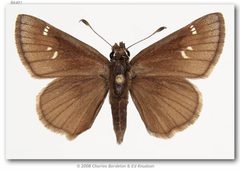
The 'dusted' appearance from pale scaling on dark wings distinguishes this from similar skippers. Atrytonopsis pittacus (white-barred skipper) has more prominent white bars rather than diffuse dusty scaling. Other Atrytonopsis species may overlap in range but differ in pattern details.
Images
Appearance
Small with wingspan 32–43 mm. Upper wing surfaces dark brown with pale grayish or whitish scaling that creates a 'dusted' appearance, particularly on forewings. Hindwings relatively unmarked. Body robust, typical of skippers. with hooked clubs.
Habitat
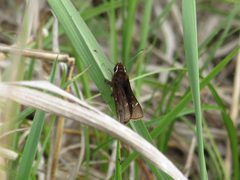
Prairie, grassland, and open meadow . Associated with native tallgrass and mixed-grass prairie where grasses are present.
Distribution
United States from eastern Wyoming, central Colorado, northern New Mexico and central Texas east to New Hampshire and Massachusetts; south to peninsular Florida and Gulf Coast. Also recorded in southern Canada (Manitoba, Saskatchewan, Vermont border region).
Seasonality
North: active May–June (one ). South: adults active March–October (two generations). Peak activity varies with latitude and local climate conditions.
Diet
Larvae feed on Andropogon gerardi (big bluestem) and Schizachyrium scoparium (little bluestem). feeding habits not explicitly documented in sources.
Host Associations
- Andropogon gerardi - larval big bluestem
- Schizachyrium scoparium - larval little bluestem
Life Cycle
Complete with , larva, pupa, and stages. Larvae develop on grasses. One per year in northern range; two generations per year in southern range. stage not explicitly documented.
Ecological Role
; herbivore in larval stage. Member of prairie dependent on native grass .
Human Relevance
for intact native prairie . Subject of watching and photography. No documented agricultural or economic significance.
Similar Taxa
- Atrytonopsis pittacusOverlapping range in southwestern US; distinguished by prominent white bars on wings rather than diffuse dusty scaling
- Atrytonopsis viennaSimilar size and ; differs in wing pattern details and distribution
More Details
Subspecies
Two recognized : Atrytonopsis hianna hianna (nominate) and Atrytonopsis hianna turneri (restricted to Kansas and Oklahoma).