
Atrytone arogos
(Boisduval & Le Conte, 1833)
Arogos Skipper, Beard-grass Skipper
Atrytone arogos, commonly known as the Arogos Skipper or Beard-grass Skipper, is an endangered in the Hesperiidae. The consists of two : the nominate A. a. arogos and A. a. iowa. It is native to grassland of the eastern and midwestern United States, where it has experienced significant declines due to destruction and poor adaptability to environmental change.
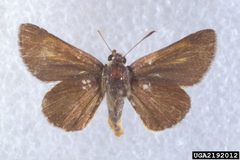
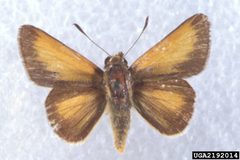
Identification
The Arogos Skipper closely resembles Atrytone delaware (Delaware Skipper), which occurs throughout the eastern United States. Accurate identification requires examination of wing border thickness and comparison of the paler yellow wing surface. The can be distinguished from other Atrytone species by its specific wing coloration and geographic occurrence in isolated prairie and grassland colonies.
Images
Appearance
have vibrant yellow wings with dark blackish-brown borders. Males have thinner black borders than females. The underside of the wings is paler yellow than the upper surface. Wingspan measures 2.9–3.7 cm. Larvae are light bluish-green with a dark green line and a light tan marked with orange and brown vertical lines.
Habitat
Occupies grasslands, prairies, flat woods, and pine savannas. Requires dense stands of native grasses suitable for larval development. plant availability is a critical component. occur in isolated colonies, often several hundred kilometers from the Atlantic Ocean or Gulf of Mexico.
Distribution
Occurs in isolated colonies in peninsular Florida, the Gulf Coast, southeast North Dakota, southern Texas, and the Colorado Front Range. Strays recorded from New Jersey to northern Arkansas. Possibly extirpated from New York, Minnesota, Wyoming, Illinois, North Carolina, South Carolina, Alabama, Iowa, Georgia, Montana, and Pennsylvania.
Diet
Larvae feed on leaves of Andropogon gerardi (big bluestem), Panicum , Calamovilfa brevipilis, and other grasses. feed on nectar from flowers including purple vetch, Canada thistle, dogbane, stiff coreopsis, purple coneflower, green milkweed, and ox- daisy.
Host Associations
- Andropogon gerardi - larval plantbig bluestem
- Panicum - larval plant of grasses
- Calamovilfa brevipilis - larval plant
Life Cycle
Females deposit single cream-colored with irregular red bands under leaves of plants. Larvae pass through five instar stages, feeding on grass leaves. Fourth-instar larvae complete feeding in autumn and enter hibernation. occurs in a pale tan chrysalis formed about three feet above ground in vegetation. emerge from chrysalis with physical appearance similar to the fifth instar larval form.
Behavior
Males perch on low vegetation near plants to locate females for mating. Perching sites are selected based on proximity to dense grass areas suitable for larval development.
Ecological Role
function as when feeding on nectar from diverse flowering plants. Larvae serve as primary consumers in grassland . The is an indicator of intact native prairie and grassland .
Human Relevance
The Arogos Skipper is listed as endangered, making it a subject of conservation concern and management planning. destruction through urban development, agricultural conversion, and fire suppression has contributed to its decline. Conservation efforts focus on preserving existing and conducting research to inform recovery strategies.
Similar Taxa
- Atrytone delawareShares physical resemblance and overlapping eastern United States range; distinguished by wing border characteristics and coloration
Misconceptions
The was originally misidentified as Papilio vitellius, resulting in early research conducted under the wrong name. This has led to debate regarding its discovery date, with some sources incorrectly citing 1833–1834 rather than the correct 1837 date for the first description.
More Details
Subspecies
Two recognized: Atrytone arogos arogos (nominate subspecies) and Atrytone arogos iowa
Conservation Status
Classified as endangered with poor predicted recovery potential due to low adaptability to environmental change and ongoing prairie loss