
Spicauda tanna
(Evans, 1952)
Tanna Longtail
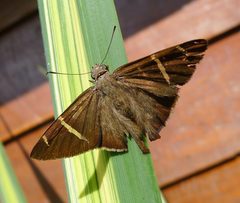
Spicauda tanna, commonly known as the Tanna Longtail, is a ( Hesperiidae) distributed from South America northward through Central America to Mexico, with rare strays reaching southern Texas. The has a wingspan of 33–38 mm and is active during the latter half of the year in its core range. Its larval plant remains unknown, and feeding habits have not been directly documented.

Pronunciation
How to pronounce Spicauda tanna: //spɪˈkɔːdə ˈtænə//
These audio files are automatically generated. While they are not always 100% accurate, they are a good starting point.
Identification
The Tanna Longtail can be distinguished from similar Urbanus/Spicauda longtails by its specific geographic distribution pattern and season. The is most likely to be encountered in Mexico and Central America during the latter half of the year. In southern Texas, where it occurs only as a rare stray, records are limited to June. Accurate identification to species level typically requires examination of genitalia or reference to detailed regional keys, as many longtail skippers are superficially similar.
Images
Appearance
Small to medium-sized skipper with a wingspan of 33–38 mm. As a member of Hesperiidae, it possesses the characteristic stocky body, large , and hooked or curved clubs typical of the . The "longtail" refers to the elongated hindwing tails present in this group. Specific wing coloration and pattern details are not well documented in available sources.
Habitat
Tropical and subtropical environments from lowland South America through Central America to Mexico. Specific preferences are not well documented, but the likely occupies forest edges, clearings, and disturbed areas where plants and nectar sources are available.
Distribution
Native to South America (Ecuador, French Guiana), Central America, and Mexico. Rare strays documented in the lower Rio Grande Valley of southern Texas, USA. GBIF records confirm presence in Middle America, North America, and South America.
Seasonality
are on wing from June to December in Mexico. In southern Texas, records are limited to June. The likely has multiple per year in tropical portions of its range, though this has not been confirmed.
Life Cycle
Complete with , larva, pupa, and stages. The larval plant is unknown. duration and number of per year have not been documented.
Behavior
are . is characteristic of Hesperiidae: rapid, darting flight with quick wingbeats interspersed with gliding. Adults have been observed visiting flowers, though specific nectar sources are not documented.
Ecological Role
likely function as when visiting flowers. Larval is unknown due to undocumented plant relationships.
Human Relevance
No significant economic or cultural importance. Occasionally noted by enthusiasts in southern Texas due to its rarity as a stray north of Mexico.
Similar Taxa
- Urbanus proteus (Long-tailed Skipper)Similar elongated hindwing tails and overall ; widely distributed and more common in overlapping regions. Distinguished by different distribution patterns and, where sympatric, by subtle wing pattern differences and genitalia.
- Other Spicauda/Urbanus speciesNumerous congeneric share the 'longtail' . Many require dissection or detailed wing pattern analysis for reliable identification, particularly in tropical portions of the range where multiple species co-occur.