
Spicauda simplicius
(Stoll, 1790)
Plain Longtail
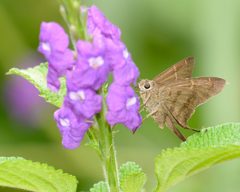
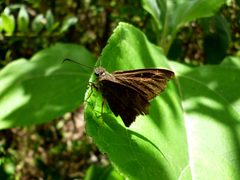
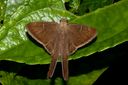
Spicauda simplicius, commonly known as the plain longtail, is a neotropical with a broad distribution from northern Mexico to northern Argentina. It exhibits cryptic brown coloration with elongated hindwing tails characteristic of the . The is highly adaptable, thriving in both degraded open and closed forests, and has been observed in urban environments. It is among the most abundant hesperiids in its range, with stable active year-round in suitable climates. The species feeds exclusively on plants in the bean (Fabaceae) and has been documented using numerous agricultural and wild plants.
Pronunciation
How to pronounce Spicauda simplicius: /spiˈkaʊdə sɪmˈplɪʃiʊs/
These audio files are automatically generated. While they are not always 100% accurate, they are a good starting point.
Identification
Distinguished from similar long-tailed skippers by its plain, unmarked brown wings without iridescent bands or spots present in related such as Urbanus proteus. The elongated hindwing tails separate it from tail-less skippers. Lack of complicates sex determination by appearance alone.
Images
Appearance
Medium-sized skipper with plain, cryptic brown coloration. Hindwings possess elongated, slender tails—diagnostic for the Spicauda. Wings lack prominent markings or iridescence, contributing to its 'plain' . is not clearly defined.
Habitat
Occurs in degraded or open , closed forests, and disturbed environments including urban areas. Collected specimens include individuals from dense Amazonian forest. Highly adaptable to anthropogenic landscape modification.
Distribution
Neotropical distribution from northern Mexico through Central America to northern Argentina. Absent from Caribbean islands except Trinidad and Tobago; recently established in Grenada. Strays reported in Texas and California, USA.
Seasonality
Active year-round in suitable ; no documented or seasonal dormancy.
Diet
Larval stage feeds on Fabaceae (bean ). Documented plants include: Arachis, Calopogonium, Centrosema, Desmodium, Galactia, Phaseolus, Rhynchosia, Teramnus, Vigna, Tipuana tipu, Glycine max, Pueraria phaseoloides.
Host Associations
- Arachis - larval
- Calopogonium - larval
- Centrosema - larval
- Desmodium - larval
- Galactia - larval
- Phaseolus - larval
- Rhynchosia - larval
- Teramnus - larval
- Vigna - larval
- Tipuana tipu - larval
- Glycine max - larval cultivated soybean
- Pueraria phaseoloides - larval
Life Cycle
Complete with , larva, pupa, and stages. Specific duration of developmental stages not documented in available sources.
Behavior
Highly abundant with stable . active year-round in suitable . Cryptic plain brown coloration with elongated hindwing tails.
Human Relevance
Uses cultivated legumes including soybean (Glycine max) and common bean (Phaseolus) as larval , indicating potential agricultural interaction. IUCN status not assessed as of 2024.
Similar Taxa
- Urbanus proteusSimilar long-tailed skipper , but distinguished by iridescent wing bands and spots absent in S. simplicius
- Spicauda (Urbanus) spp.Congeneric with similar elongated hindwing tails; require examination of wing pattern details for separation
More Details
Genome
sequenced: 610.1 Mb assembly with 32 chromosomal pseudomolecules (30 plus Z and W ), 18,506 protein-coding genes, and 15.54 kb mitochondrial genome. Specimen from Tarapoto, Peru.
Sex determination
ZW system identified; lacks clearly defined in external .