
Achalarus toxeus
(Plötz, 1882)
Coyote Cloudywing, Coyote Skipper
Achalarus toxeus is a in the Hesperiidae, commonly known as the Coyote Cloudywing or Coyote Skipper. It occurs in the southwestern United States and Mexico. The was historically placed in the Thorybes but is now classified in Achalarus based on morphological and molecular evidence.
Pronunciation
How to pronounce Achalarus toxeus: //əˈkælərəs ˈtɒksiəs//
These audio files are automatically generated. While they are not always 100% accurate, they are a good starting point.
Identification
Distinguished from similar cloudywing skippers by the forewing spot pattern: A. toxeus typically shows a single prominent white spot with smaller, more irregular discal spots, whereas A. lyciades (Hoary Edge) has a continuous pale band along the hindwing margin. Thorybes generally have more extensive and regular forewing spotting. Examination of male genitalia provides definitive separation from . The 'Coyote' refers to the species' association with dry, scrubby rather than vocalizations.
Images
Appearance
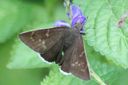
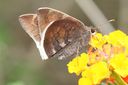
Medium-sized skipper with dark brown to blackish wings. Forewings have a variable pattern of pale spots, usually including a distinct white spot near the apex and additional small pale spots in the discal area. Hindwings are generally unmarked dark brown. The body is robust with a furry . have hooked tips (apiculus) characteristic of Hesperiidae. Underside of wings is slightly paler with reduced spotting.
Habitat
Arid and semi-arid scrublands, desert washes, thorn scrub, and dry canyon slopes. Associated with riparian corridors in otherwise xeric environments. Elevation range from near sea level to approximately 1500 meters.
Distribution
Southwestern United States (Arizona, New Mexico, Texas, southern California, southern Nevada, southern Utah) and Mexico (Sonora, Chihuahua, Baja California, and southward through the Mexican plateau to Oaxaca).
Seasonality
fly from late March through October in most of range, with peak activity in late spring and again in late summer. Multiple per year in southern portions of range; fewer in northern areas.
Diet
Larval plants: documented on various Fabaceae including Dalea , Psorothamnus scoparius (smokebush), and possibly other leguminous shrubs. feed on nectar from flowers including desert legumes and other available blooms.
Host Associations
- Dalea - larval plantmultiple used
- Psorothamnus scoparius - larval plantsmokebush
Life Cycle
Complete . laid singly on plant leaves or flowers. Larvae construct leaf shelters by folding or tying leaves with silk, feeding within. occurs in the leaf shelter or in ground litter. stage appears to be as pupa or possibly partially grown larva, though details require confirmation.
Behavior
are rapid, darting fliers typical of skippers, often staying close to the ground in scrub vegetation. Males perch on low vegetation to await females. Both sexes visit flowers for nectar. Adults frequently rest with wings partially open, forewings and hindwings held at different angles.
Ecological Role
of desert and semi-desert flowering plants. Larval herbivore on nitrogen-fixing leguminous shrubs. Serves as prey for birds, spiders, and other .
Human Relevance
Occasional subject of watching and photography in the southwestern US. No significant economic impact. for healthy desert scrub .
Similar Taxa
- Achalarus lyciadesOverlaps in range; distinguished by continuous pale marginal band on hindwing underside and different forewing spot arrangement
- Thorybes bathyllusSimilar size and dark coloration; Thorybes have more extensive, regularly arranged forewing spots and lack the isolated spot pattern
- Thorybes pyladesNorthern and eastern relative with more numerous and evenly spaced forewing spots; range overlap limited in Texas and New Mexico
More Details
Taxonomic history
Originally described as Hesperia toxeus by Plötz in 1882. Long classified in Thorybes, but transferred to Achalarus based on genitalic and molecular . The Achalarus was resurrected to accommodate this and A. lyciades, which share derived characters not present in Thorybes.
Conservation status
Not evaluated by IUCN. Appears secure throughout most of range, though loss from urbanization and agricultural conversion affects some . Climate change may expand suitable habitat northward while reducing it in core desert areas.