
Peridea ferruginea
(Packard, 1864)
Chocolate prominent, Chocolate Birch Prominent
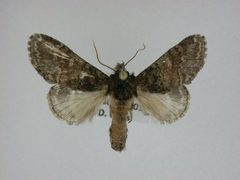
Peridea ferruginea, the chocolate prominent, is a of prominent in the Notodontidae. It was described by Alpheus Spring Packard in 1864 and occurs in North America. The species was historically confused with Peridea bordeloni, a river birch that was distinguished as a separate species in 2018. The MONA/Hodges number for this species is 7921.
Pronunciation
How to pronounce Peridea ferruginea: /pɛˈrɪdeɪə ˌfɛruˈdʒiːnɪə/
These audio files are automatically generated. While they are not always 100% accurate, they are a good starting point.
Identification
Identification requires careful separation from the closely related Peridea bordeloni, which was formerly considered . P. bordeloni larvae specialize on river birch (Betula nigra), while P. ferruginea has broader associations. may be distinguished by genitalic characters, though precise diagnostic features for field identification are not well documented in available sources.
Images
Distribution
North America. Recorded from Canada (Manitoba, Saskatchewan) and the United States (Vermont and presumably other eastern and central states).
Host Associations
- Betula - larval food plantBirch , though specific preferences require clarification given historical confusion with P. bordeloni
Similar Taxa
- Peridea bordeloniFormerly identified as P. ferruginea; distinguished as a separate in 2018 based on larval specialization on river birch (Betula nigra) and subtle morphological differences
More Details
Taxonomic history
In 2018, Miller et al. distinguished Peridea bordeloni as a separate from P. ferruginea based on larval specialization and morphological evidence. This split resolved long-standing confusion in the identification of these birch-feeding prominents.
Catalogue reference
MONA ( of North America) or Hodges number: 7921