
Peridea angulosa
(Smith, 1797)
Angulose Prominent
Peridea angulosa is a in the Notodontidae, commonly known as the angulose prominent. First described by James Edward Smith in 1797, this is widely distributed across eastern North America. are active from late spring through mid-summer and are associated with oak-dominated . The larvae feed exclusively on Quercus species.
Pronunciation
How to pronounce Peridea angulosa: /pɛrˈiːdeɪ əŋˈɡuːloʊsə/
These audio files are automatically generated. While they are not always 100% accurate, they are a good starting point.
Identification
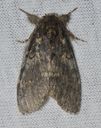
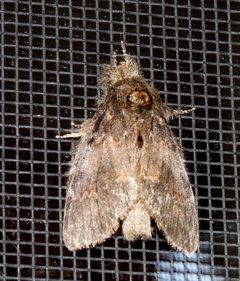
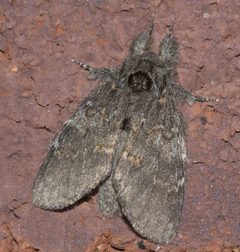
Distinguished from other Peridea by the angular forewing pattern. The thick, fuzzy body and resting posture with wings curled around the or tented over the back separate it from superficially similar noctuid .
Images
Appearance
have a wingspan of 35–45 mm. The body is relatively thick and fuzzy, typical of prominent moths. The forewings display angular markings that give the its . The overall coloration is cryptic, blending with tree bark when at rest.
Habitat
Deciduous woodlands, particularly those dominated by oak (Quercus) .
Distribution
Eastern North America from southern Canada (Manitoba, Saskatchewan, Ontario, Quebec) south to Florida and west to Texas.
Seasonality
are on wing from May to August, with peak activity varying by latitude.
Diet
Larvae feed on Quercus (oak) . feeding habits are not documented.
Host Associations
- Quercus - larval food plantSpecific oak not distinguished in sources
Life Cycle
Complete with , larval, pupal, and stages. Detailed timing is not well documented.
Ecological Role
Larval herbivore on oaks; contributes to nutrient cycling in deciduous forest . Specific ecological interactions are not well documented.
Human Relevance
Not considered economically significant. Occasionally encountered by naturalists and enthusiasts.
Similar Taxa
- Other Peridea speciesSimilar body form and association; distinguished by forewing pattern details
- Hyperaeschra georgica (Georgian Prominent)Also a Notodontidae with thick, fuzzy body and oak-feeding larvae; differs in forewing pattern and geographic distribution
Sources and further reading
- BugGuide
- Wikipedia
- GBIF taxonomy match
- iNaturalist taxon
- NCBI Taxonomy
- Catalogue of Life
- Sphingidae | Beetles In The Bush | Page 2
- Let’s make a deal! | Beetles In The Bush
- The Moth and Me | Beetles In The Bush
- Saturniidae | Beetles In The Bush | Page 2
- Noctuidae | Beetles In The Bush | Page 3
- blog carnivals | Beetles In The Bush