
Didugua argentilinea
Druce, 1891
Silvered Prominent
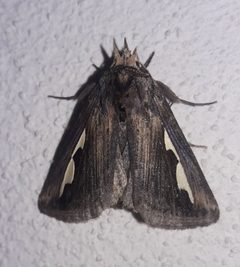
Didugua argentilinea, commonly known as the Silvered Prominent, is a of prominent in the Notodontidae. It occurs in North America and is recognized by distinctive silver-gray coloration with prominent lines on the forewings. The species was described by Druce in 1891.
Pronunciation
How to pronounce Didugua argentilinea: //daɪˈduːɡə ɑːrˌdʒɛntɪˈlɪniə//
These audio files are automatically generated. While they are not always 100% accurate, they are a good starting point.
Identification
Distinguished from similar notodontid by the combination of silvery-white longitudinal forewing stripe and overall gray coloration without strong contrasting patterns. Resembles some Nadata but lacks the reddish or brownish tones common in that . The prominent silver line is more distinct than in related Didugua species. Larvae, if encountered, have distinctive tufted projections and coloration differing from other prominent moth caterpillars.
Images
Appearance
exhibit silver-gray forewings with a prominent silvery-white longitudinal line running from base to apex, bordered by darker gray shading. Hindwings are pale gray to whitish with minimal patterning. The body is robust and densely hairy, matching the forewing coloration. Wingspan ranges approximately 35–45 mm. are bipectinate in males, less so in females.
Habitat
Deciduous and mixed forests, particularly areas with oak and hickory. Found in woodland edges, suburban parks, and riparian corridors with mature hardwood trees. Elevation range extends from lowlands to lower montane zones.
Distribution
Eastern and central North America, ranging from southern Canada (Ontario, Quebec) through the eastern United States to Texas and Florida. Absent from the far western United States and most of the Great Plains.
Seasonality
are active from late spring through summer, with peak typically in May–July depending on latitude. Single brooded in northern portions of range; possible partial second in southern regions. Overwinters as pupa in soil or leaf litter.
Life Cycle
Complete with four stages: , larva, pupa, . Larvae feed on foliage of hardwood trees, particularly oaks (Quercus) and hickories (Carya). occurs in a loose cocoon in soil or concealed in leaf litter. Adults do not feed.
Behavior
are and attracted to light. Males are active fliers and may be detected by their erratic patterns near forest edges. Females deposit singly or in small groups on plant leaves. Larvae are solitary feeders and rest along leaf midribs or twigs when not feeding.
Ecological Role
Larvae function as primary consumers in deciduous forest , contributing to nutrient cycling through herbivory on oak and hickory foliage. serve as prey for including bats and night-foraging birds. Pupae are subject to by ground-foraging vertebrates and .
Human Relevance
Occasional minor pest of ornamental oaks and hickories, though are rare and damage is typically insignificant. Attracted to outdoor lighting, where it may be encountered by homeowners. Of interest to lepidopterists and naturalists due to its distinctive appearance.
Similar Taxa
- Nadata gibbosaSimilar size and gray coloration, but lacks the prominent silvery longitudinal line; forewings more uniformly colored with subtle patterning only.
- Didugua pectinataCongeneric with overlapping range; distinguished by less distinct wing lines and generally darker, more brownish-gray coloration.
- Lochmaeus manteoAnother notodontid with gray forewings, but exhibits more complex patterning with multiple wavy transverse lines rather than a single prominent longitudinal stripe.
More Details
Taxonomic History
Originally described by Herbert Druce in 1891 based on specimens from North America. The Didugua was historically placed in various notodontid before molecular and morphological studies confirmed placement in Nystaleinae.
Conservation Status
Not evaluated by IUCN; appears secure throughout range with no significant documented declines. Benefits from widespread availability of oak-hickory forest in eastern North America.