
Raphia frater abrupta
(Schmidt & Anweiler, 2014) Grote, 2014
Abrupt Brother
Raphia frater abrupta is a of in the Noctuidae, commonly known as the Abrupt Brother. It was described from North American specimens and is distinguished from the nominate subspecies by subtle morphological differences in wing pattern. The subspecies occurs in prairie and open woodland across parts of Canada and the northern United States.
Pronunciation
How to pronounce Raphia frater abrupta: //ˈræfiə ˈfreɪtər əˈbrʌptə//
These audio files are automatically generated. While they are not always 100% accurate, they are a good starting point.
Identification
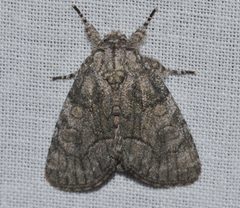
Distinguished from Raphia frater frater by the more abrupt termination of the dark basal area on the forewing, with the boundary line running more perpendicular to the wing margin rather than oblique. The name 'abrupta' refers to this sharply defined wing pattern. Overall coloration tends toward gray-brown with reduced tones compared to eastern of the nominate subspecies.
Images
Habitat
Prairie , open woodlands, and parkland regions with aspen groves. Associated with sandy or well-drained soils in the Canadian Prairie Provinces and adjacent areas of the northern Great Plains.
Distribution
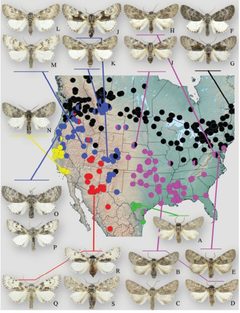
Recorded from Alberta, Saskatchewan, and Manitoba in Canada, and from Vermont in the northeastern United States. The distribution represents the western and northern portion of the range, with centered in the Prairie Provinces.
Seasonality
are active in spring, with period typically occurring from April through June depending on latitude and seasonal conditions. The single coincides with bud break and early flowering of plants.
Life Cycle
Overwinters as pupa in soil. emerge in spring and lay on foliage. Larvae feed through summer and pupate in autumn to complete the cycle.
Behavior
are and attracted to light. Males are active fliers in early evening, seeking females via detection. Larvae are ground-dwelling when not feeding, hiding in leaf litter during daylight hours.
Ecological Role
Larval stage functions as a folivore in early successional and prairie edge . serve as prey for bats and night-flying birds. The contributes to nutrient cycling through herbivory and subsequent deposition of in soil systems.
Similar Taxa
- Raphia frater fraterNominate occurring in eastern North America; distinguished by more oblique boundary between basal and wing areas, with greater coloration in the forewing median area.
- Raphia piaSympatric congeneric with similar size and wing shape; distinguished by more uniform gray forewing lacking strong basal- contrast, and more southern distribution in the Great Plains.
More Details
Taxonomic history
Originally described as a distinct by Schmidt and Anweiler in 2014 based on specimens from Alberta, subsequently treated as a of Raphia frater by Grote in the same year. The taxonomic status reflects clinal variation in wing pattern across the species range.
Sources and further reading
- BugGuide
- GBIF taxonomy match
- iNaturalist taxon
- A bumble bee, or not a bumble bee, that is the question: Miner bees, Anthophora abrupta — Bug of the Week
- Useful & abundant, African 'Zam' palm newly described for science | Blog
- Bug Eric: Two Spiny-butts
- Issue #150 of PhytoKeys marks a decade of revolutionising open plant systematics | Blog