
Chrysanympha formosa
(Grote, 1865)
Formosa looper, Formosa Looper Moth
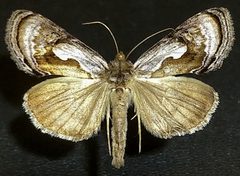
Chrysanympha formosa, commonly known as the Formosa looper, is a noctuid found in eastern North America. First described by Augustus Radcliffe Grote in 1865, this ranges from Newfoundland west to Manitoba and south to the Appalachian Mountains of North Carolina and Tennessee. are active during summer months, with periods varying by latitude. The larvae feed on specific plants in the Ericaceae .
Pronunciation
How to pronounce Chrysanympha formosa: //ˌkrɪsəˈnɪmfə fɔrˈmoʊsə//
These audio files are automatically generated. While they are not always 100% accurate, they are a good starting point.
Identification
The specific wing pattern markings that distinguish C. formosa from related Plusiinae are not documented in available sources. Identification to species level likely requires examination of genitalia or reference to specialized regional keys.
Images
Appearance
have a wingspan of 30–35 mm. As a member of the Plusiinae, it likely exhibits the characteristic looped resting posture of looper moths, with forewings held tent-like over the body.
Habitat
Specific preferences are not well documented. Based on its geographic range and larval plants, it likely occurs in habitats supporting Vaccinium and Gaylussacia , including bogs, heathlands, and forested areas with acidic soils.
Distribution
North America: Newfoundland west to Manitoba, south to the mountains of North Carolina and Tennessee. Specific provincial/state records include Alberta, Manitoba, Saskatchewan, and Vermont.
Seasonality
are on wing from July to August in Alberta and from June to August in the Great Smoky Mountains National Park. There is one per year.
Diet
Larvae have been recorded feeding on Gaylussacia dumosa (dwarf huckleberry) and Vaccinium (blueberries, cranberries). feeding habits are not documented.
Host Associations
- Gaylussacia dumosa - larval plantdwarf huckleberry
- Vaccinium - larval plantblueberries, cranberries
Life Cycle
One per year. stage is not specified in available sources.
Similar Taxa
- Other Plusiinae speciesLooper moths share similar body plan and resting posture; precise identification requires detailed examination
More Details
Taxonomic history
Originally described as Leptina formosa by Grote in 1865, later transferred to Chrysanympha.
Sources and further reading
- BugGuide
- Wikipedia
- GBIF taxonomy match
- iNaturalist taxon
- NCBI Taxonomy
- Catalogue of Life
- Cicindela formosa pigmentosignata (the “reddish-green sand tiger beetle”) | Beetles In The Bush
- Cicindela lengi vs. Cicindela formosa | Beetles In The Bush
- A Termite-Control Twofer: How Baiting One Colony of Formosan Subterranean Termites Can Knock Out the Colony Next Door