
Abrostola
Ochsenheimer, 1816
spectacle moths
Species Guides
4- Abrostola microvalis(minute oval abrostola)
- Abrostola ovalis(oval abrostola)
- Abrostola parvula
- Abrostola urentis(Spectacled Nettle Moth)
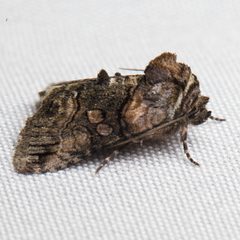
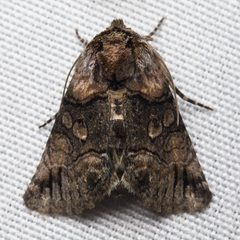
Abrostola is a of noctuid in the tribe Abrostolini, characterized by distinctive thoracic markings resembling spectacles or goggles. The genus includes at least two well-studied European : A. tripartita (the spectacle) and A. triplasia (the dark spectacle). Both species are associated with nettle as a primary larval plant. The genus has been the subject of recent genomic research, with chromosomally complete assemblies available for both A. tripartita and A. triplasia.
Pronunciation
How to pronounce Abrostola: /əbˈrɒstələ/
These audio files are automatically generated. While they are not always 100% accurate, they are a good starting point.
Identification
Members of Abrostola are distinguished from similar noctuids by prominent tufts of grey or dark hairs on the that form a pattern resembling spectacles or goggles when viewed from the front. This feature is particularly conspicuous in A. tripartita. A. triplasia is generally darker overall and lacks the sharp contrast of the spectacle pattern seen in A. tripartita. Accurate identification requires examination of genitalia in some cases.
Images
Habitat
where larval plants occur, particularly areas with abundant nettle (Urtica dioica). A. triplasia is additionally associated with acidic soils and is most frequent in western regions of its range. occurs as pupae among ground litter or under bark.
Distribution
Palaearctic region, with records from Europe (including Scandinavia: Denmark, Norway, Sweden), temperate Asia extending to China and Japan, and North America (Vermont, USA). In the UK and Ireland, A. triplasia is most frequent in western areas with relatively few Scottish records.
Seasonality
period varies by latitude and . A. tripartita: single in northern UK (May–July); two generations in southern UK (May–July and July–September). Specific seasonality for other species is not well documented.
Diet
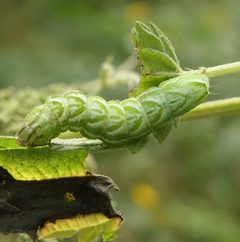
Larvae feed on nettle (Urtica dioica); A. triplasia additionally uses hop (Humulus lupulus). of A. tripartita have been observed feeding at flowers including red valerian (Centranthus ruber) and sage (Salvia).
Host Associations
- Urtica dioica - larval foodplantprimary for multiple
- Humulus lupulus - larval foodplantused by A. triplasia
- Centranthus ruber - nectar sourceA. tripartita
- Salvia - nectar sourceA. tripartita
Life Cycle
Overwinters as pupa. A. tripartita exhibits or patterns depending on latitude. Larvae of A. triplasia feed mostly at night.
Behavior
Larvae are feeders. The larva of A. triplasia possesses two yellow ' spots' that have been suggested to function as snake mimicry for deterrence. activity varies geographically.
Human Relevance
Subject of genomic research; assemblies for A. tripartita and A. triplasia contribute to lepidopteran genomic resources. A. tripartita has increased significantly in abundance in the UK in recent decades, making it a of interest for monitoring studies.
Similar Taxa
- Other Plusiinae generashare characteristics but lack the distinctive thoracic 'spectacle' markings; genitalia examination often required for definitive separation
More Details
Genomic resources
Chromosomally complete assemblies are available for both A. tripartita (381 Mb, 31 chromosomal pseudomolecules, 99.0% BUSCO completeness) and A. triplasia (362.7 Mb, 31 chromosomal pseudomolecules, 15.34 kb mitochondrial genome, 11,532 protein-coding genes). Both assemblies include the Z .