
Sympistis tenuistriga
McDunnough, 1940
Thin-lined Sallow
Sympistis tenuistriga is a described by McDunnough in 1940, currently treated as a synonym of Sympistis badistriga. It belongs to the Noctuidae (owlet moths) and is known from the Canadian prairie provinces and Vermont. The "Thin-lined Sallow" refers to its characteristic wing pattern. Limited observational data exists, with 19 records on iNaturalist.
Pronunciation
How to pronounce Sympistis tenuistriga: //sɪmˈpɪstɪs ˌtɛn.juˈɪs.trɪ.ɡə//
These audio files are automatically generated. While they are not always 100% accurate, they are a good starting point.
Identification
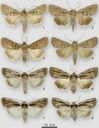
As a synonym of Sympistis badistriga, specimens historically identified as S. tenuistriga would show the diagnostic features of that : forewings with a thin, dark line and sallow (yellowish-brown) ground color. Distinction from other Sympistis species requires examination of genitalia and wing pattern details. The specific epithet "tenuistriga" (thin-lined) suggests the narrow stripe pattern.
Images
Habitat
Records from Alberta, Manitoba, and Saskatchewan indicate association with prairie and transition zones. The Vermont record suggests broader or possible misidentification requiring verification.
Distribution
Documented from Alberta, Manitoba, and Saskatchewan in Canada, and Vermont in the United States. Distribution reflects the range of the accepted S. badistriga.
Similar Taxa
- Sympistis badistrigaS. tenuistriga is currently synonymized under this ; they represent the same biological entity.
- Sympistis speciesMany Sympistis share sallow coloration and lined forewing patterns, requiring careful examination of genitalia and precise wing markings for separation.
More Details
Taxonomic Status
Catalogue of Life and GBIF both list S. tenuistriga as a synonym of S. badistriga McDunnough, 1921. The 1940 description likely represented intraspecific variation or a misidentified series.
Data Limitations
With only 19 iNaturalist observations and minimal published literature, most biological details remain undocumented. The epithet provides the only direct clue to diagnostic .