
Aseptis fumosa
Grote, 1879
Aseptis fumosa is a noctuid described by Augustus Radcliffe Grote in 1879. It is widespread across western North America, from western Canada through the western United States to California. The occupies diverse ranging from coastal chaparral to dry conifer forests and shrub steppe. are active in spring and early summer, with larvae feeding on specific woody shrubs in the Rosaceae and Rhamnaceae .
Pronunciation
How to pronounce Aseptis fumosa: /æˈsɛptɪs fjuːˈmoʊsə/
These audio files are automatically generated. While they are not always 100% accurate, they are a good starting point.
Identification
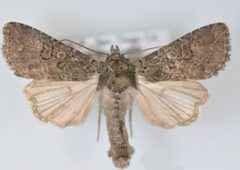
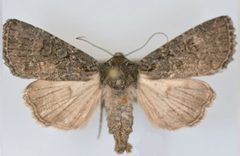
Distinguished from similar Aseptis by the uniformly smoky dark blackish brown forewings without strong pattern contrast. The weakly figure-eight shaped spot and the specific arrangement of antemedial and postmedial lines as dots on the are diagnostic. Male specimens can be identified by the pearly gray hindwing with accentuated asymmetry. The green larva with white stripe and broad red and white lateral stripe is distinctive among western noctuid larvae.
Images
Appearance
have a wingspan of 31.5–38 mm. Forewings are uniformly smoky dark blackish brown with brown filling of the antemedial and postmedial lines, most evident as dots on the . The spot is weakly figure-eight shaped; the spot and short claviform spot are black and filled with ground color or slightly darker . Male hindwings are pearly gray to the discal spot, accentuating asymmetry. Female hindwings are smoky dark with dark but less conspicuous veins. Larvae are smooth and green with a white stripe and broad red and white lateral stripe.
Habitat
Occurs in diverse including coastal chaparral, dry conifer forest, and shrub steppe. The shows ecological flexibility across western North American , from coastal environments to interior montane and semi-arid regions.
Distribution
Western North America: western Canada (British Columbia, Alberta), Washington, Nebraska, Colorado, Utah, Arizona, Nevada, and California. Records indicate presence across a broad latitudinal and elevational range in the western United States and adjacent Canada.
Seasonality
are on wing from April or May through July. The period spans late spring to mid-summer, with exact timing varying by latitude and elevation.
Diet
Larvae feed on Purshia (including Purshia tridentata, bitterbrush), Cercocarpus species (mountain mahogany), Ceanothus species (including Ceanothus integerrimus, deerbrush), and Adenostoma fasciculatum (chamise). feeding habits are not documented.
Host Associations
- Purshia tridentata - larval food plantbitterbrush
- Ceanothus integerrimus - larval food plantdeerbrush
- Adenostoma fasciculatum - larval food plantchamise
- Cercocarpus - larval food plantmountain mahogany
- Purshia - larval food plantbitterbrush
- Ceanothus - larval food plantCalifornia-lilac
Life Cycle
Complete with , larva, pupa, and stages. Larvae are known to be smooth green with distinctive white stripe and broad red and white lateral stripe. details are not documented. Adults emerge in spring to early summer.
Ecological Role
Larval herbivore on woody shrubs; contributes to nutrient cycling and serves as prey for . The specialized feeding on chaparral and montane shrub suggests a role in shaping vegetation structure in these , though specific ecological impacts have not been quantified.
Human Relevance
No documented economic importance or direct human interactions. The may serve as an indicator of healthy shrubland in western North America. Not known to be a pest of agriculture or forestry.
Similar Taxa
- Other Aseptis speciesSimilar members share the general noctuid body plan and dark coloration, but differ in forewing pattern details, spot shapes, and hindwing coloration. A. fumosa is distinguished by its uniformly smoky dark forewings and specific spot .