
Aseptis fanatica
Mustelin, 2006
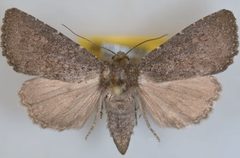
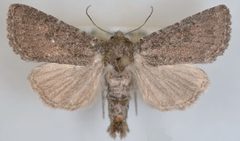
Aseptis fanatica is a noctuid described by Tomas Mustelin in 2006, with the name chosen as the antithesis of Aseptis ethnica. The species exhibits notable geographic variation in forewing coloration, ranging from dark chocolate-brown in southern California to nearly black in the Pacific Northwest, with some central California individuals appearing smooth bright red-brown. It occurs in brushland and open forest across western North America.
Pronunciation
How to pronounce Aseptis fanatica: /əˈsɛptɪs fəˈnætɪkə/
These audio files are automatically generated. While they are not always 100% accurate, they are a good starting point.
Identification
Distinguished from similar Aseptis by combination of geographic color variation and specific maculation: black-filled spot, pale yellowish costal spots at antemedial and postmedial lines, and serrate black postmedial line on well-marked specimens. The peppered appearance from scattered pale on dark background is distinctive. Darker northern may be confused with other dark noctuids but lack the strong contrasting patterns of many .
Images
Habitat
Brushland and open forest, primarily in montane zones of southern California at 1000–2000 meters elevation. Occurs at progressively lower elevations northward through California, Oregon, and Washington.
Distribution
Western North America: Washington, Oregon, California, and Baja California Norte, Mexico.
Seasonality
fly from early May to August in southern California; mid-summer in the Cascade Range.
Diet
Larvae feed on Arbutus menziesii (Pacific madrone) and various Arctostaphylos , including Arctostaphylos uva-ursi (bearberry).
Host Associations
- Arbutus menziesii - larval food plantPacific madrone
- Arctostaphylos uva-ursi - larval food plantbearberry
- Arctostaphylos spp. - larval food plantvarious manzanita
Ecological Role
Larval herbivore on woody plants in Ericaceae; specific ecological functions otherwise undocumented.
Similar Taxa
- Aseptis ethnicaSister from which A. fanatica was distinguished; name selected as direct antithesis ('fanatic' vs. 'heathen')
More Details
Etymology
name derived from Latin 'fanatica' (meaning fanatic), chosen by Mustelin as the antithesis of Aseptis ethnica ('heathen').