
Aseptis binotata
Walker, 1865
Rusty Shoulder Knot Moth
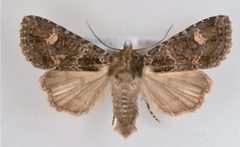
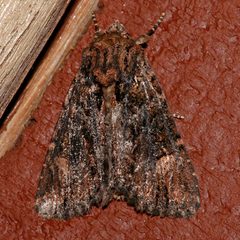
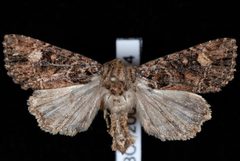
Aseptis binotata, commonly known as the Rusty Shoulder Knot , is a noctuid moth first described by Francis Walker in 1865. It is the most variable species in its with respect to forewing color and pattern, exhibiting a broad range of brown, gray, and reddish tones. The species is widespread across western North America, from northern Mexico to south-central British Columbia, and occurs across diverse elevations and types.
Pronunciation
How to pronounce Aseptis binotata: /əˈsɛptɪs baɪˈnoʊteɪtə/
These audio files are automatically generated. While they are not always 100% accurate, they are a good starting point.
Identification
Distinguished from other Aseptis by its exceptional variability in forewing color and pattern strength. The combination of the large pale postreniform patch (in dark forms), convex antemedial line with light tan fill, and presence of a short black basal dash helps separate it from . The black wedges near the outer margin below the apex and outlined forewing spots are additional diagnostic features. Pale specimens may require careful examination of remaining dark markings.
Images
Appearance
have a wingspan of 29.5–35 mm. Forewing coloration is highly variable, ranging from brownish, warm dark brown, pale to medium gray brown, yellowish light brown, to reddish brown depending on locality. Dark specimens display a large pale yellowish postreniform patch bisected by the dark postmedial line. The antemedial line is strongly convex laterally and filled with light tan. Black markings include a series of wedges near the outer margin below the apex, outlines of the three forewing spots, and in most specimens a short black basal dash. Pale specimens may appear washed out or have contrasting dark markings. Larvae are green with a white and red lateral stripe.
Habitat
Occurs from sea level to elevations exceeding 2000 meters. Found in diverse including dense forest and shrub desert, indicating broad ecological .
Distribution
Widespread in western North America, west of south-central Alberta, Wyoming, and Nebraska. Along the Pacific Coast, ranges from northern Mexico to south-central British Columbia.
Seasonality
period varies with latitude and elevation. In the south, flight begins in March at low elevations and continues April through July in mountainous areas. In the north, flight begins later and extends into August.
Diet
Larvae feed on various broadleaf trees and shrubs. Recorded plants include big-leaf maple (Acer macrophyllum), ocean spray (Holodiscus discolor), and Ceanothus . Additional recorded food plants include Oemleria, Symphoricarpos, and Ribes species.
Host Associations
- Acer macrophyllum - larval food plantbig-leaf maple
- Holodiscus discolor - larval food plantocean spray
- Ceanothus - larval food plantmultiple
- Oemleria - larval food plant
- Symphoricarpos - larval food plant
- Ribes - larval food plant
Life Cycle
Complete with , larva, pupa, and stages. Larval stage is green with a white and red lateral stripe. Specific details on site, number of , and stage are not documented.
Ecological Role
Larval herbivore on broadleaf trees and shrubs; contributes to nutrient cycling and serves as prey for and .
Similar Taxa
- Other Aseptis speciesAseptis binotata is distinguished by being the most variable in forewing color and pattern within the ; specific markings (postreniform patch, antemedial line shape, black basal dash) aid separation