
Agrochola lota
(Clerck, 1759)
Red-line Quaker
A medium-sized noctuid found in damp across Europe and Asia. fly in autumn and are attracted to light. Larvae feed on willow and sallow, hiding in spun leaves during daylight hours. The was introduced to Newfoundland and has been the subject of long-term monitoring studies in Europe.
Pronunciation
How to pronounce Agrochola lota: /ˌæɡroʊˈkoʊlə ˈloʊtə/
These audio files are automatically generated. While they are not always 100% accurate, they are a good starting point.
Identification
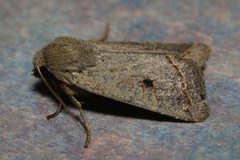
Distinguished from similar autumn noctuids by the combination of grey-brown forewings with reddish tinge, dark hindwings, and the black lower half of the stigma. The submarginal line angled on 7 is a useful character. Separation from the Asian sister Agrochola plumbea requires genital morphological examination. From Agrochola lychnidis (Beaded Chestnut) by overall coloration and marking details.
Images
Habitat
Humid including river shores, floodplains, clearings, bogs, and wet meadows. In the Alps, found at altitudes up to just over 1500 metres.
Distribution
Europe (except Scandinavia), Armenia, Asia Minor, east across the Palearctic to the Altai Mountains and western Siberia. Introduced to Newfoundland, Canada.
Seasonality
fly from September to October.
Diet
Larvae feed on catkins of sallow and willow (Salix) when young, progressing to leaves when mature.
Host Associations
- Salix - larval food plantcatkins when young, leaves when mature
Life Cycle
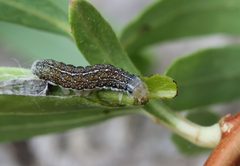
spherical, initially yellowish white, turning dark reddish-brown before hatching; covered with strongly curled longitudinal ribs. Young larvae bluish grey; fully grown larvae grey to grey-brown, finely blackened above, whitish grey to ochre below. and dorsolateral lines white, partly slightly interrupted; white point warts framed in black. Pupa with four curved thorns on wide, short . Overwinters as larva.
Behavior
attracted to light. Larvae hide in spun leaves by day and feed at night.
Human Relevance
Subject of long-term monitoring in Europe; 29-year study in Prague (1967–1995) contributed to understanding minimum data requirements for detecting insect abundance trends.
Similar Taxa
- Agrochola plumbeaAsian sister ; requires genital morphological examination for reliable separation
- Agrochola lychnidisSimilar autumn-flying noctuid; differs in coloration and marking details
More Details
Population trends
A 29-year light-trapping study in Prague (1967–1995) found that detecting reliable long-term trends in abundance requires minimum 15 years of data for increasing and 17 years for decreasing populations; 20–25 years recommended for robust conclusions.
Colour forms
Multiple named aberrations described: ab. rufa (entirely ), ab. suffusa (blackened, Ireland), ab. pallida (whitish grey, England), ab. subdita (paler grey, Amasia).