
Enargia fausta
Schmidt, 2010
Etched Sallow
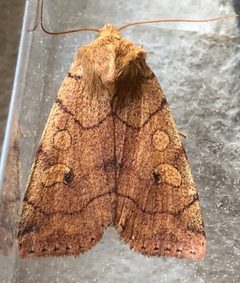
Enargia fausta is a noctuid described by Schmidt in 2010. It is restricted to the forest and boreal-deciduous forest transition zone of North America, ranging from central Alberta to New Brunswick with eastern records extending to the Ottawa River Valley. The was long confused with Enargia infumata due to morphological similarity but differs in its more limited geographic distribution, lacking the Rocky Mountain and northern extensions of that species. are active in late summer, and larvae feed on specific hardwood tree species.
Pronunciation
How to pronounce Enargia fausta: /ɛnˈɑːrdʒiə ˈfaʊstə/
These audio files are automatically generated. While they are not always 100% accurate, they are a good starting point.
Identification
Most reliably distinguished from the similar Enargia infumata by geographic distribution: E. fausta does not range south along the Rocky Mountains and does not extend as far north as E. infumata. Specimens from the Rocky Mountain region or extreme northern latitudes likely represent E. infumata rather than E. fausta. Reports from north-eastern Ohio require verification and may represent misidentifications.
Images
Habitat
Restricted to the forest and the transition zone between boreal and deciduous forests. Occupies appropriate patches within this zone, presumably including mixed woodlands with tree present.
Distribution
North America: central Alberta eastward to New Brunswick; eastern range extends south to the Ottawa River Valley. Presumed to occur in suitable in northern New York and New England, though not confirmed by examined specimens. Not found south along the Rocky Mountains.
Seasonality
on wing from late July to early September, with the majority of records occurring after mid-August.
Diet
Larvae have been recorded feeding on Betula papyrifera (paper birch), Populus tremuloides (quaking aspen), and Populus balsamifera (balsam poplar). feeding habits unknown.
Host Associations
- Betula papyrifera - larval foodplantpaper birch
- Populus tremuloides - larval foodplantquaking aspen
- Populus balsamifera - larval foodplantbalsam poplar
Life Cycle
Complete with , larval, pupal, and stages. Larval stage associated with specific hardwood tree . Timing of other life stages not documented.
Behavior
activity during late summer months. Specific behavioral details such as patterns, mating, or oviposition not documented.
Ecological Role
Larval herbivore on deciduous trees in and mixed forest . Specific ecological impacts or interactions not documented.
Human Relevance
No documented economic or agricultural significance. Etymology of specific epithet references Faust of German legend, reflecting the author's interest in classical literature rather than practical human association.
Similar Taxa
- Enargia infumataLong confused with E. fausta due to morphological similarity; distinguished by broader geographic distribution including Rocky Mountains and more northern latitudes
Misconceptions
Reports from north-eastern Ohio attributed to this require verification and may represent misidentifications of E. infumata or other .
More Details
Etymology
The specific epithet fausta is derived from Faustus (Faust), the alchemist of German legend who sold his soul to Mephistopheles in exchange for knowledge. The ending was amended for euphony with the name Enargia and is treated as a noun in apposition.
Taxonomic history
Described by Schmidt in 2010, this was separated from the long-confused Enargia infumata based on geographic and morphological evidence.