
Cerapteryx
Curtis, 1833
antler moth
Species Guides
1- Cerapteryx graminis(Antler Moth)
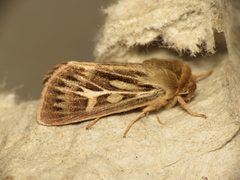
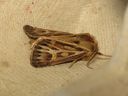
Cerapteryx is a of noctuid established by Curtis in 1833, containing two recognized : Cerapteryx graminis (the antler moth) and Cerapteryx megala. The genus is best known from the antler moth, which has been introduced to Newfoundland where it established in the 1960s and became a minor agricultural pest. The genus is native to Europe and has been recorded from Scandinavia and Denmark.
Pronunciation
How to pronounce Cerapteryx: //ˌsɛɹæpˈtɛɹɪks//
These audio files are automatically generated. While they are not always 100% accurate, they are a good starting point.
Images
Habitat
Hay and pasture fields, lawns, and grassland environments. In Newfoundland, established occupy approximately 60 km in the greater St. John's area.
Distribution
Native to Europe (recorded from Denmark, Norway, Sweden). Introduced and established in Newfoundland, Canada since 1966, specifically in the greater St. John's area and surrounding localities.
Behavior
attracted to black light traps, as has been observed in monitoring programs.
Ecological Role
Cerapteryx graminis functions as a minor agricultural pest in introduced range, affecting hay and pasture production. Natural controls including (CegraNPV) and Spiroplasma sp. bacterium have been documented in .
Human Relevance
Cerapteryx graminis has limited economic importance as a pest of hay and pasture fields, and lawns in Newfoundland. Black light trapping has been used operationally for monitoring from 1966–1978.
More Details
Population Dynamics
of Cerapteryx graminis have been associated with agents including a -specific and Spiroplasma bacteria, which may function as natural population controls.
Taxonomic Note
The contains only two : Cerapteryx graminis (Linnaeus, 1758) and Cerapteryx megala (Alphéraky, 1882). Most ecological and economic data pertain to C. graminis; information specific to C. megala is not available in provided sources.
Sources and further reading
- BugGuide
- Wikipedia
- GBIF taxonomy match
- iNaturalist taxon
- NCBI Taxonomy
- Catalogue of Life
- Characterisation of a nucleopolyhedrovirus and Spiroplasma sp. bacterium associated with outbreaking populations of the Antler moth Cerapteryx graminis
- A REVIEW OF THE LIFE HISTORY, POPULATION LEVELS, AND SPREAD OF THE ANTLER MOTH, CERAPTERYX GRAMINIS (LEPIDOPTERA: NOCTUIDAE), IN NEWFOUNDLAND