
Perigonica
Smith, 1890
Species Guides
5- Perigonica angulata(cutworm moth)
- Perigonica eldana
- Perigonica fulminans(cutworm moth)
- Perigonica pectinata(cutworm moth)
- Perigonica tertia
Perigonica is a of in the Noctuidae, established by Smith in 1890. The genus contains five described , all named by Smith or Dyar between 1888 and 1911. These moths are found in North America, with records from the United States and Canada. The genus is part of the diverse owlet moth family, which includes many species.
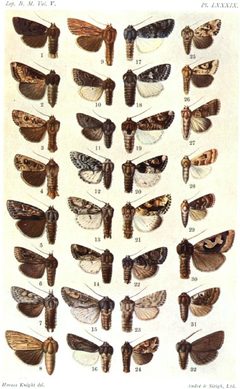
Pronunciation
How to pronounce Perigonica: //ˌpɛrɪˈɡɒnɪkə//
These audio files are automatically generated. While they are not always 100% accurate, they are a good starting point.
Identification
within Perigonica can be distinguished by wing pattern details, particularly the presence and configuration of angular markings on the forewings. Perigonica angulata is characterized by its angular forewing pattern. Perigonica pectinata exhibits comb-like (pectinate) structures on the male , referenced in its specific epithet. Accurate identification to species level requires examination of genitalia or reference to original species descriptions.
Images
Distribution
North America, with documented occurrences in the United States and Canada. Specific have regional distributions: Perigonica tertia is recorded from Arizona and Texas, while other species range more broadly across western and central North America.
Similar Taxa
- Other Noctuidae generaPerigonica lacks obvious external diagnostic features that readily separate it from related noctuine ; dissection and genitalia examination are often required for confident identification.
More Details
Etymology
The name Perigonica derives from Greek roots, with 'peri-' meaning 'around' and '-gonica' relating to angles or corners, likely alluding to the angular wing patterns characteristic of the type .
Taxonomic history
Perigonica johnstoni was synonymized under Perigonica pectinata, and Perigonica fermata under Perigonica tertia, reducing the number of recognized from seven to five.