
Ochropleura
Hübner, 1821
Species Guides
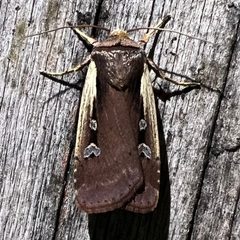
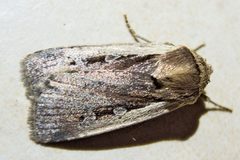
1- Ochropleura implecta(Flame-shouldered Dart)
Ochropleura is a of owlet moths (Noctuidae) described by Jacob Hübner in 1821, containing approximately 30 distributed across Europe, Africa, and Asia. The genus includes the well-known Flame Shoulder (O. plecta) and Radford's Flame Shoulder (O. leucogaster), both characterized by distinctive forewing patterns with pale costal streaks. Several species have undergone recent range expansions, with O. leucogaster establishing resident in the UK since 2022 after previously occurring only as a rare migrant.
Pronunciation
How to pronounce Ochropleura: /ˌɔkroʊˈplʊərə/
These audio files are automatically generated. While they are not always 100% accurate, they are a good starting point.
Identification
Members of Ochropleura are distinguished from similar noctuid by forewing patterns featuring a prominent pale straw-colored to yellowish-white streak along the costal margin, often accompanied by dark longitudinal markings. O. plecta (Flame Shoulder) shows a bright straw-colored stripe with a black streak running from the base through the oval and kidney stigmata. O. leucogaster (Radford's Flame Shoulder) has slightly more elongate wings with smaller stigmata compared to O. plecta, with reddish-brown forewings and yellowish-white costal streak. -level identification requires examination of genitalia in many cases.
Images
Habitat
varies by . O. plecta occupies gardens, farmland, hedgerows, moorland, woodland, and wetlands. O. leucogaster has been collected from coastal sites in southwest England; its broader habitat preferences in its native Mediterranean and North African range are not well documented.
Distribution
The occurs across the Palearctic and Afrotropical regions. O. plecta is widespread and abundant throughout Great Britain, Ireland, the Isle of Man, and Channel Islands. O. leucogaster is native to the Mediterranean, North Africa, and Middle East, with recent northward expansion into Europe and established residency on the southwest coast of UK since 2022. Records also exist from Scandinavia (Denmark, Norway, Sweden) and North America (Vermont, USA), though these may represent vagrants or misidentifications.
Seasonality
O. plecta: active late April through September; two in southern Britain, single brooded in northern Britain (June–July). O. leucogaster: not well documented in source material.
Diet
Larvae of O. leucogaster feed on various low-growing plants. Larval diet of O. plecta not specified in available sources.
Life Cycle
O. plecta: partial in south, in north. Specific life stages and developmental duration not detailed. Other Ochropleura : insufficient data.
Behavior
O. plecta readily attracted to light traps. O. leucogaster underwent rapid status change in UK from scarce migrant to abundant resident between 2020–2022, with large numbers now occurring on parts of the southwest coast.
Human Relevance
O. plecta is a common and widespread frequently encountered by naturalists and in ecological surveys. O. leucogaster has become a subject of biogeographic interest due to its recent of the UK. sequences have been published for both O. plecta and O. leucogaster as part of the Darwin Tree of Life and related initiatives.
Similar Taxa
- O. leucogaster vs. O. plectaO. leucogaster has slightly more elongate wings with smaller stigmata; historically confused but now distinguishable by wing shape and pattern details
More Details
Genomic resources
-level assemblies available for O. plecta (643.9 Mb, 32 chromosomes, 19,016 protein-coding genes) and O. leucogaster (545.70 Mb, 31 chromosomes, 12,155 protein-coding genes). Both assemblies include complete mitochondrial genomes (~15.3–15.4 kb).
Taxonomic notes
O. ignota has been suggested as a possible synonym of O. plecta. The contains both Palearctic and Afrotropical , with several described from Madagascar (O. marojejy, O. portieri, O. sidamona).